Power Distribution Block vs Busbar: Which Is Better for Electrical Panels?
Published: Author: Rachel
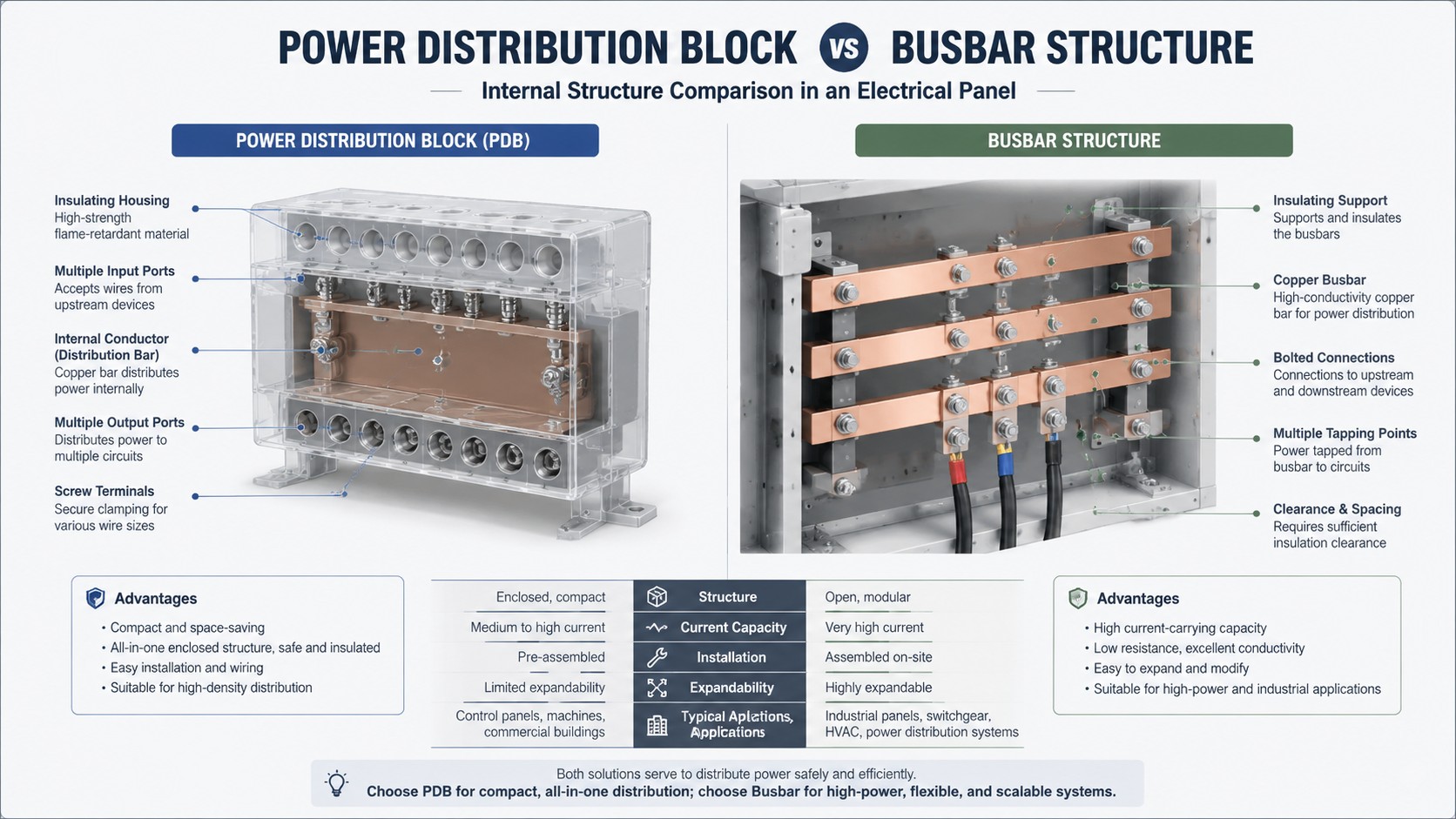
When you open an electrical panel, the power distribution path is usually one of two things: a compact distribution block that splits one feeder into several outgoing cables, or a long busbar that carries a common supply across the panel to many devices. Both do the same broad job, but they are built for different layouts. Choose a power distribution block for concentrated feeder splitting at one location; choose a busbar when the common supply must run across a wider panel area or feed many devices along the same path. This guide compares both approaches across current capacity, panel space, expansion, cost, and installation, and explains when they work best together.
Quick Answer: Distribution Block or Busbar?
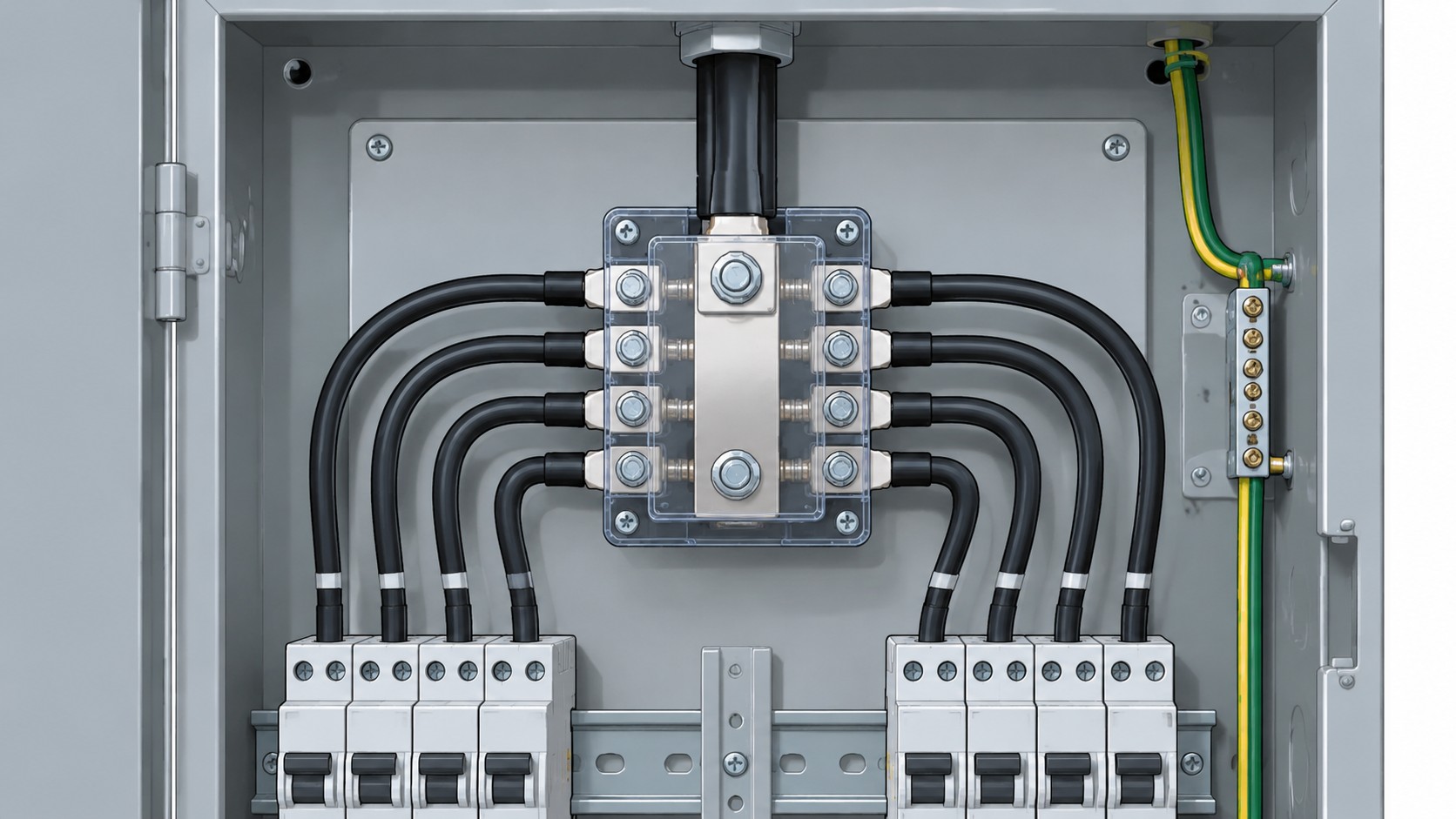
A power distribution block is a packaged component with one input termination and several defined output terminations, all sharing an internal conductive bar. It solves one problem: bringing one large feeder conductor into a fixed location and splitting it into a limited number of branch conductors.
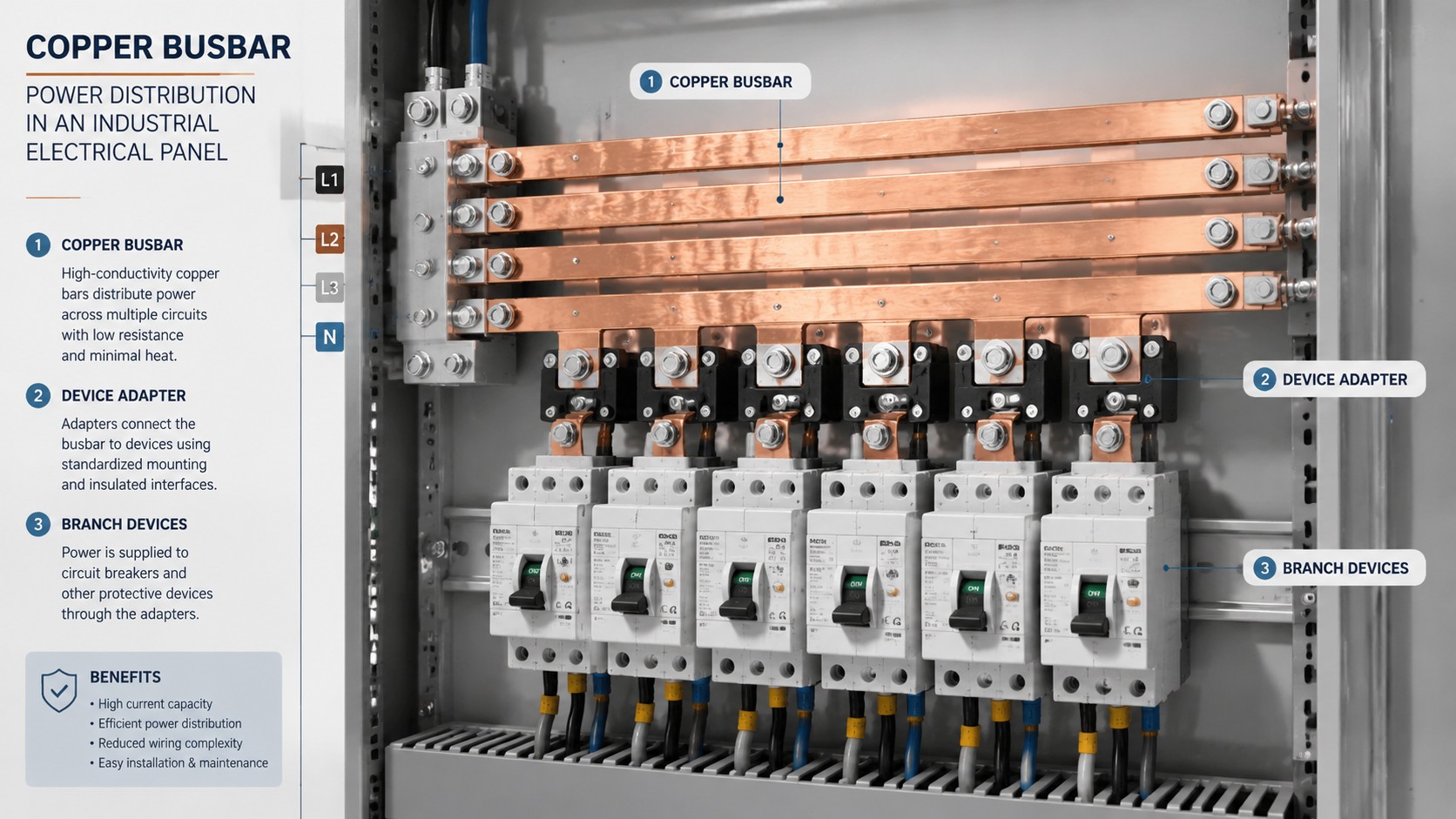
A busbar is a conductive bar or strip, usually copper or aluminum, that creates a common power path you can extend through part of the panel. Compatible devices and branch conductors connect along that path, which suits distributed layouts, many repeated connections, and higher current.
The practical rule: below roughly 250 A to 400 A, or when you need 2 to 10 outgoing conductors at one location, a distribution block is usually the simpler, cheaper choice. Above that range, or when power must reach devices spread across a large cabinet, a busbar system usually wins on space, installation time, and per-connection cost. Larger panels often use both: a busbar backbone with distribution blocks for local branch groups.
What Is a Power Distribution Block?
A power distribution block is an insulated component that accepts one incoming conductor (or a small number of inputs) and provides multiple defined outgoing connection points. All outputs share the same internal conductive bar, so every branch receives the same potential directly from the source in parallel.
Typical characteristics:
Current ratings commonly from about 90 A up to 760 A for standard industrial models, with specialized UL 1059-recognized blocks reaching well over 1,000 A.
Fixed terminal layout : a stated number of input and output terminals per pole, with published conductor ranges for each.
Insulated, finger-safe housing , often with transparent covers for visual inspection without de-energizing the panel.
DIN-rail or panel mounting , pre-assembled with screw or mechanical terminations, ready to install without custom fabrication.
Pole counts from 1 to 12, matching the number of branch circuits you need to feed.
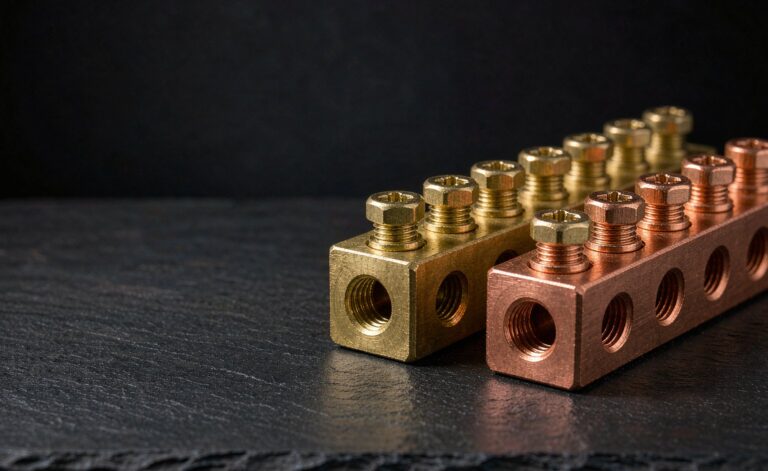
Distribution blocks are best understood as short, insulated busbars with defined cable terminals. They standardize the branching point, keep incoming and outgoing wiring easy to identify, and repeat cleanly across production batches. Our DIN-rail power distribution block article covers the mounting styles in more detail.
What Is a Busbar?
A busbar is a solid conductive bar or strip that forms a common electrical path across part of an electrical panel. It is made from copper or aluminum, sized by cross-section for the current it must carry, and installed with supports, insulation, covers, and connection accessories. Devices and branch conductors connect to the bar at compatible points along its length.
Key characteristics:
Current capacity from about 225 A up to 6,000 A in modular busway systems, depending on cross-section and material.
Distributed layout : the common supply runs to wherever the devices are, instead of routing a separate main cable to each distribution point.
System approach : a complete busbar installation includes the bar, supports, covers, adapters, and compatible device interfaces, not just the conductor.
Expansion-friendly : additional connection positions can be planned along the bar, which is harder with a fixed terminal block.
Better heat and fault handling at high current, with large surface area for dissipation.
Power Distribution Block vs Busbar: Key Differences
Here is the side-by-side comparison that matters when you are designing a panel:
Aspect
Power Distribution Block
Busbar
Main function
Concentrated one-to-many branching at one location
Common power path across a wider panel area
Typical current range
About 90 A to 760 A per pole (specialized blocks higher)
About 225 A up to 6,000 A in modular systems
Connection layout
Fixed input and output terminals, defined conductor ranges
Connection points depend on system design and adapters
Installation
Install one block, terminate the permitted conductors
Install bar, supports, covers, and compatible accessories
Panel layout
Compact and concentrated
Distributed along part of the panel
Expansion
Limited by spare terminals and space
Planned with additional connection positions
Best fit
Local distribution to a few branch circuits
Panel-wide distribution, many repeated connections
Upfront cost
Lower per location
Higher design and materials investment
Certification
Published per-model ratings (UL 1059, IEC 60947-7-1)
Verified as part of the complete assembly
Current Capacity: Where the Decision Flips
The most common selection mistake is choosing by current rating alone, but current is where the two approaches diverge most clearly. Standard distribution blocks handle roughly 90 A to 760 A per pole; modular busbar systems extend from about 225 A to thousands of amps. Industry guides frequently put the practical crossover around 250 A to 400 A: below that, a distribution block delivers better value; above it, the busbar’s larger conductor surface and lower per-connection cost take over.
That crossover is not a hard rule. The branch count matters just as much. If one location must feed 12 outgoing circuits at 300 A total, a single distribution block may still be the cleaner answer. If the panel has 30 devices spread across a large cabinet, a busbar system usually saves more wiring, mounting, and labor than any number of blocks.
Also check the fault level. Distribution blocks carry a published short-circuit rating (SCCR) and are verified as individual components; busbar systems are usually verified as part of the complete switchboard assembly, which can be an advantage in very high fault environments.
When to Use a Power Distribution Block
Choose a power distribution block when the task is localized branching and you want a defined, repeatable connection point:
Localized branching: the incoming supply reaches one area of the panel and divides into a limited number of outgoing circuits.
Standardized panels: you build several similar machines and want the same part number, wiring sequence, and inspection method across batches.
Defined terminations: a stated input/output configuration simplifies BOMs, drawings, and assembly instructions.
Limited space: a compact block concentrates several branches in a small area, provided there is room for conductor bends and tool access.
Moderate loads: branch currents within the block’s published rating, typically below the 250 A to 400 A crossover.
Choose a busbar when the common supply must extend across the panel or feed many devices along one path:
Panel-wide distribution: several devices are positioned along a cabinet, so a shared bar near the loads replaces long parallel cables.
High current: applications above about 400 A, where the busbar’s surface area handles heat and fault forces better.
Many repeated connections: breakers, fuse bases, and contactors connect along the bar with standardized adapters instead of individual lugs.
Future expansion: extra connection positions can be planned along the bar without redesigning the panel.
Faster assembly: a modular busbar system can cut installation labor significantly by eliminating measuring, cutting, stripping, and routing dozens of parallel cables.
Note that a raw copper bar is not the same as a complete modular busbar system. When comparing costs, evaluate the full assembly, including supports, covers, adapters, and device interfaces.
Can You Use a Distribution Block and a Busbar Together?
Yes, and in real panels they frequently work as a pair. A common architecture uses a busbar as the main distribution backbone for the cabinet, then taps off with distribution blocks at the point where each local group of loads needs a clean, defined branching point.
For example, a motor control center might run a three-phase busbar down the back of the enclosure. At each starter section, a distribution block takes the busbar feed and splits it into the few branch conductors that feed the contactor, control transformer, and auxiliary devices in that section. The busbar handles the high-current backbone; the block keeps each section’s local wiring tidy and serviceable.
This hybrid approach is worth considering whenever your answer to “where is the current going?” has two parts: a long-distance, high-current path (busbar) and a local, low-to-medium split at the endpoint (distribution block).
How to Choose: Five Questions
Work through these five questions to narrow the decision:
What current per path? Above roughly 400 A, lean toward a busbar; below 250 A, a distribution block usually delivers better value. Between 250 A and 400 A, weigh the other factors.
How many outgoing circuits, and where? A handful of branches at one location points to a distribution block; many connections spread across the panel point to a busbar.
How much panel space and access? Distribution blocks need space for conductor bends and tool access at one spot; busbars run along the panel and need cover clearance and inspection access.
Will the panel grow? If expansion is likely, a busbar with planned connection positions is easier to extend than a block with fixed spare terminals.
What certification does the project need? Confirm the distribution block’s per-model ratings (UL 1059, IEC 60947-7-1) or the busbar assembly’s system certification matches the target market.
If the answer points to a distribution block, compare the distribution block range; if it points to a busbar, review the busbar range and its compatible accessories.
Common Mistakes to Avoid
Choosing by current rating alone. Conductor range, branch count, layout, service access, and certification matter just as much as amps.
Comparing one block with the price of a bare bar. A complete busbar system includes supports, covers, and adapters; compare like for like.
Forcing a busbar into a small panel. If the supply reaches one location and feeds only a few circuits, a block is simpler and cheaper.
Using a block where the feeder exceeds its rating. Verify the total branch current stays within the block’s published rating, with margin for inrush and ambient temperature.
Skipping finger-safe covers. On exposed busbars and blocks, covers reduce the risk of accidental contact during maintenance.
FAQ
Which is better, a power distribution block or a busbar?
Neither is universally better. A distribution block is better for concentrated feeder splitting at one location; a busbar is better for panel-wide distribution, higher current, and many repeated connections. Many panels use both together.
At what current should I switch from a distribution block to a busbar?
Industry guidance commonly puts the crossover around 250 A to 400 A. Below that range a distribution block usually gives better value; above it, a busbar system becomes more economical per connection and handles heat better.
Can a busbar and a distribution block be used together?
Yes. A typical architecture runs a busbar backbone for the cabinet and uses distribution blocks at each local load group to split the feed into a few defined branch circuits.
Is a power distribution block the same as a busbar?
No. A distribution block is a packaged component with fixed input and output terminals around an internal conductive bar. A busbar is a conductive bar or strip that forms a common power path, usually part of a larger system with supports, covers, and adapters.
Do I still need overcurrent protection with a distribution block or busbar?
Yes. Neither a standard distribution block nor a busbar provides circuit protection. Your design still needs the appropriate protective devices upstream or on each branch.
Conclusion
The choice between a power distribution block and a busbar comes down to the shape of your panel and the path the current must take. Use a distribution block to split one feeder into a few branches at a defined location; use a busbar to carry a common supply across a wider panel or to many devices; use both when the architecture needs a backbone plus local splitting. Match the choice to current, branch count, panel space, expansion plans, and the certifications your market requires, and the panel will be easier to build, inspect, and maintain. If you are sourcing either component, compare the distribution block and busbar ranges or contact the manufacturer for help matching the distribution architecture to your application.
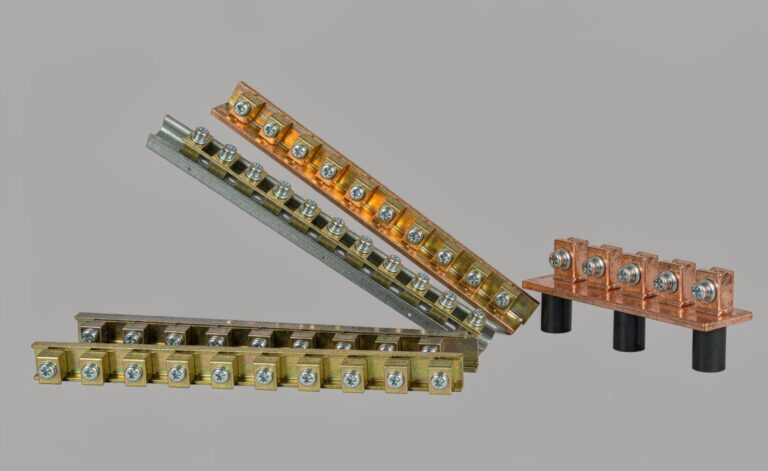
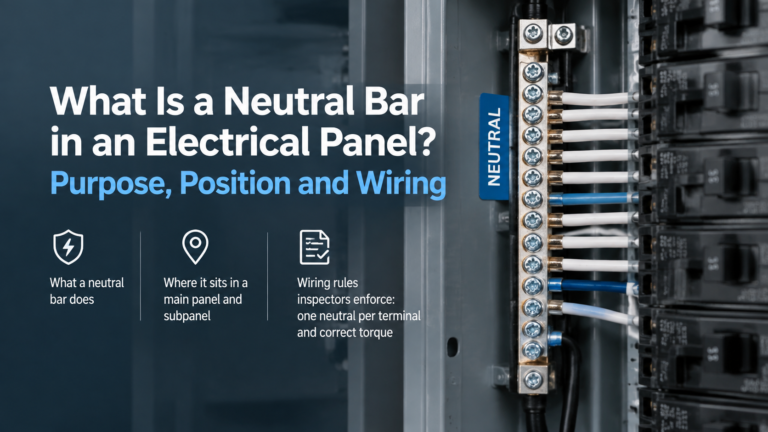
Four constraints determine neutral bar size: terminations needed, unbalanced current per NEC 220.61, largest conductor and mounting centres — with real dimension charts.
The neutral bar is the return path for every line-to-neutral load. How it works, where it sits, when it must be isolated from the enclosure, and the rules that govern it.