Pin Type Busbar vs Fork Type Busbar
When several miniature circuit breakers need to be supplied from one incoming source, individual jumper wires can quickly make a distribution board difficult to build, inspect, and maintain. An MCB busbar provides a cleaner way to distribute power across a row of breakers, reducing wiring congestion and helping panel builders create a more standardized layout.
However, selecting an MCB busbar is not only about current rating or pole number. One of the most important decisions is choosing between a pin type busbar and a fork type busbar.
At first glance, both products perform the same job: they distribute incoming power to multiple circuit breakers. In practice, their terminal geometry, installation method, and compatibility requirements are different. Choosing the wrong type can lead to poor terminal engagement, difficult assembly, unstable contact, or unnecessary rework during panel production.
This guide explains the real differences between pin type busbar vs fork type busbar systems, how to check MCB compatibility, and what OEM buyers, panel builders, and distributors should confirm before placing an order.
Pin Type Busbar vs Fork Type Busbar: The Main Difference
The core difference is the way each busbar connects to the circuit breaker terminal.
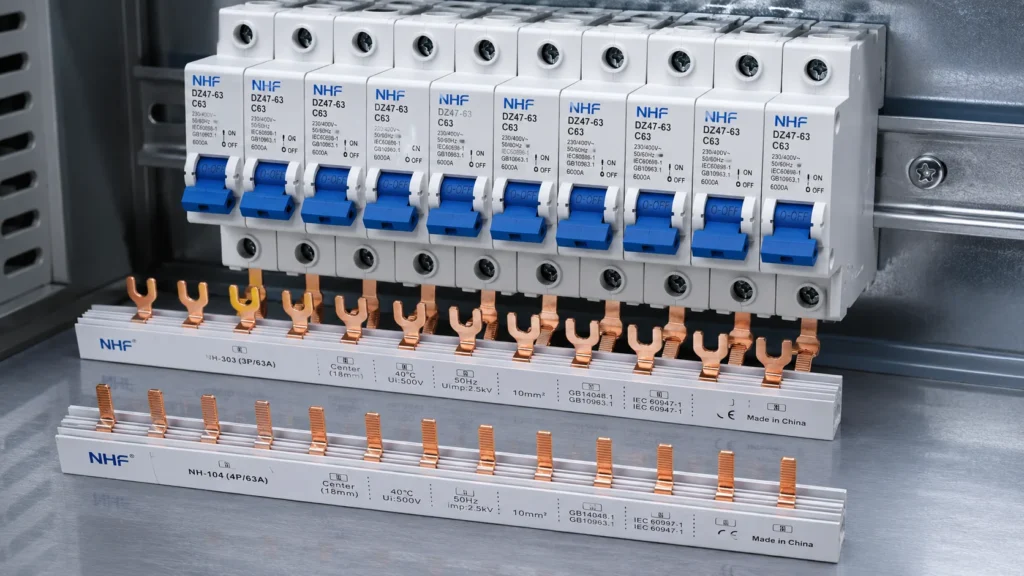
A pin type busbar uses straight conductive teeth or pins. These pins are inserted directly into MCB terminals designed to accept them. The connection is compact and efficient when the terminal cage or insertion port matches the busbar profile.
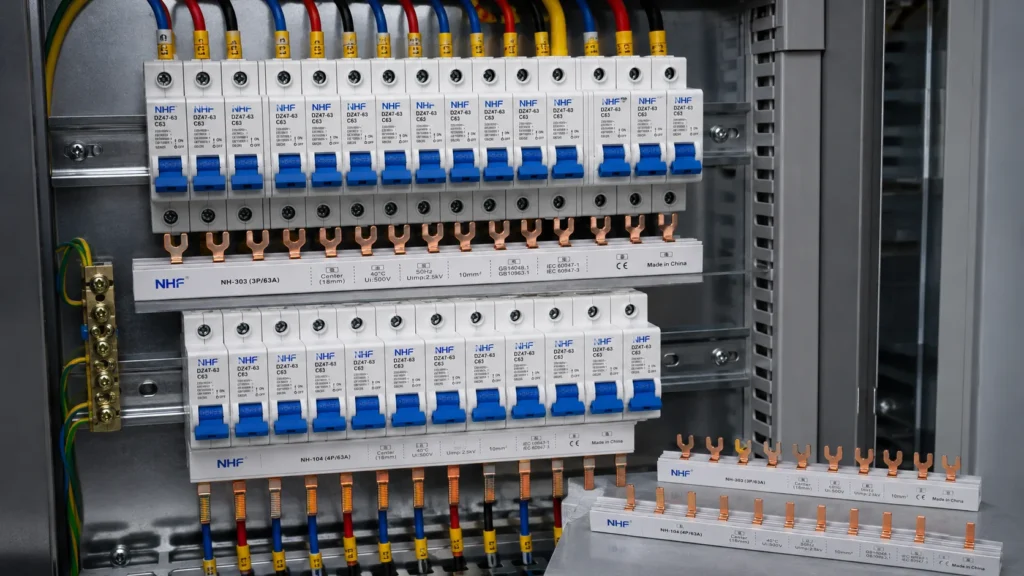
A fork type busbar uses U-shaped fork terminals. Each fork is positioned around or beneath the MCB terminal screw or clamping point, then secured when the screw is tightened according to the breaker manufacturer’s instructions.
Neither design is universally better. The right choice depends first on the MCB terminal structure, then on the panel layout, installation workflow, current requirement, pole configuration, and maintenance needs.
| Selection Factor | Pin Type Busbar | Fork Type Busbar |
|---|---|---|
| Connection method | Straight pins insert into compatible MCB terminals | U-shaped forks clamp beneath the terminal screw or pressure plate |
| Main compatibility requirement | MCB must accept pin-style connections | MCB must have a suitable screw-clamp terminal |
| Installation workflow | Fast insertion and standardized assembly | Requires positioning under the screw before tightening |
| Maintenance approach | Best where compatible devices are standardized | Convenient where screw-terminal devices are already used |
| Key purchase check | Pin dimensions and terminal entry geometry | Fork width, fork depth, screw size, and clamp geometry |
| Typical use | Modular distribution boards and OEM electrical panels | Distribution boards and control panels using screw-clamp MCBs |

What Is a Pin Type Busbar?
A pin type busbar, also called a pin comb busbar or pin type MCB busbar, is a conductive strip with evenly spaced straight pins. It is installed along a row of compatible MCBs to distribute power from one incoming point to multiple outgoing circuits.
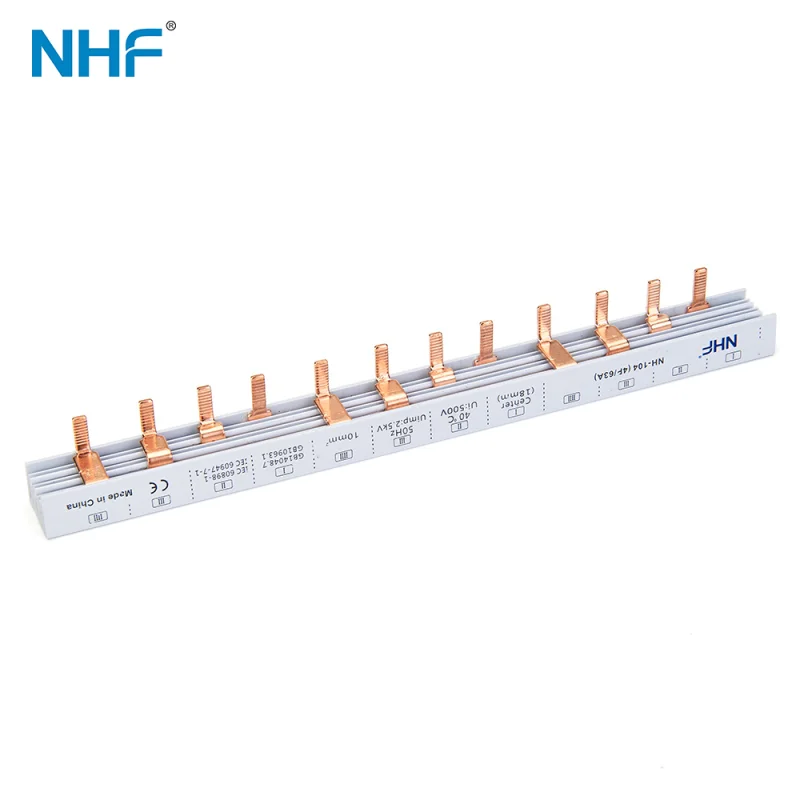
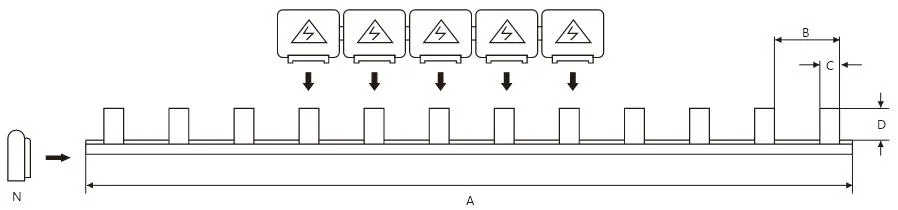
The main advantage of a pin type busbar is installation efficiency. When the MCB terminal is designed for pin insertion, the busbar can create a clean and repeatable connection across the entire breaker row. This is especially useful for panel builders producing standardized assemblies in volume.
Pin type busbars are commonly considered for:
- Residential and commercial distribution boards
- Modular low-voltage panels
- OEM electrical equipment
- Repetitive control-panel assemblies
- Projects where compatible MCBs are already standardized
A pin type busbar is a strong option when the panel uses one approved MCB platform and the terminal design has been verified. The key point is compatibility: do not assume that every MCB with a screw terminal will also accept a pin busbar.
Before selecting a pin type design, check the breaker data sheet, physical terminal profile, pole spacing, and the busbar manufacturer’s dimensional drawing.
What Is a Fork Type Busbar?
A fork type busbar, also known as a fork comb busbar or U-type busbar, uses fork-shaped conductive teeth. Each fork is installed under the relevant MCB terminal screw or clamping point before the screw is tightened.
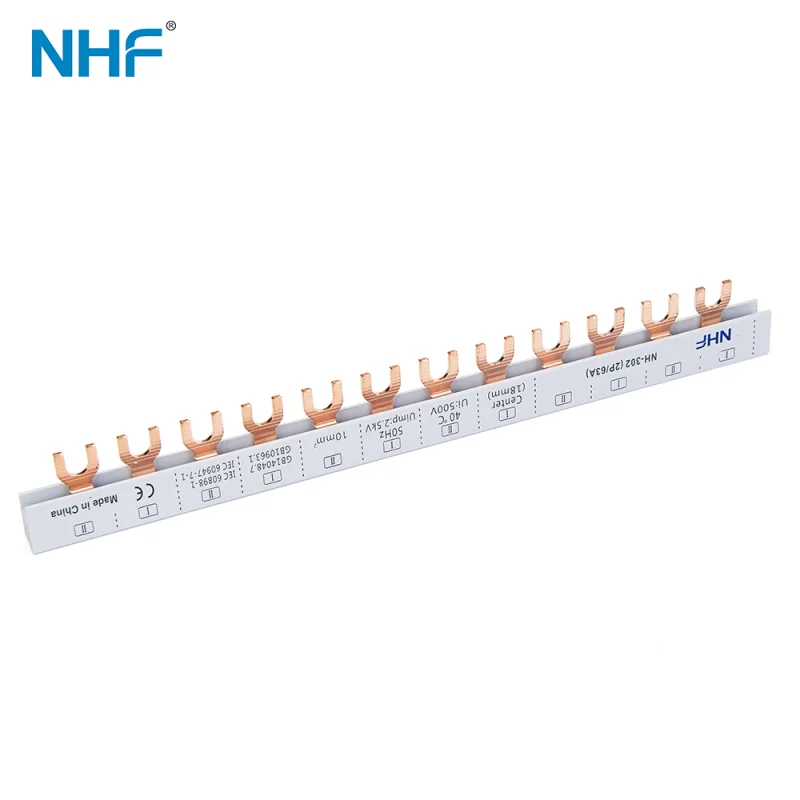
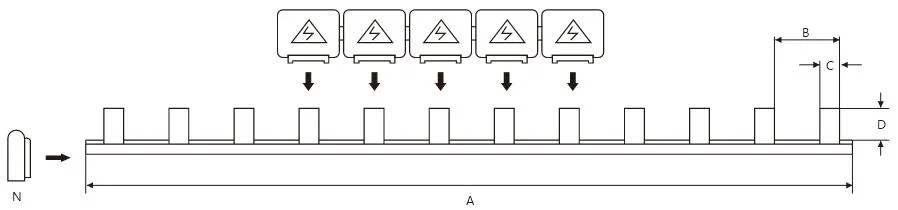
This design is often selected for circuit breakers that use standard screw-clamp terminal structures. The fork shape provides a defined mechanical position at each breaker connection and can be practical when installers need to work with screw-terminal MCBs already specified for a project.
Fork type busbars are commonly used in:
- Low-voltage distribution boards
- Industrial control panels
- Retrofit projects using existing MCB models
- Electrical cabinets with screw-clamp circuit breakers
- Projects requiring a familiar screw-tightening installation process
The quality of a fork type connection depends on more than the fork itself. The fork must match the terminal geometry, and the terminal screw must be tightened according to the circuit breaker manufacturer’s specified torque. A loose connection can increase resistance and heat generation; excessive tightening can damage the terminal or conductor interface.
How to Choose Between Pin Type and Fork Type Busbars
The correct decision should follow a compatibility-first process rather than a price-first process.
1. Check the MCB Terminal Design First
This is the most important step.
Some circuit breakers are designed for pin-type busbars, some are designed for fork-type busbars, and some may accept more than one connection style. Do not choose based only on the breaker brand name or product appearance.
Ask these questions before ordering:
- Does the MCB terminal accept a straight pin busbar?
- Is the terminal designed for a fork placed under the screw clamp?
- Does the breaker manufacturer provide a compatible busbar reference?
- Is there enough terminal space for both the incoming feeder and the busbar?
- Does the terminal design change across different MCB series from the same brand?
When possible, test the busbar with the actual circuit breaker model before full production. A physical fit check is especially important for OEM projects, distributor orders, and mixed-brand panels.
2. Confirm Pole Configuration and Pitch
The pole configuration must match the electrical system and breaker layout.
Common options include:
- 1P busbar
- 2P busbar
- 3P busbar
- 4P busbar
- 1P+N busbar
- 3P+N busbar
The pitch, or center-to-center distance between each tooth, must also match the spacing of the circuit breakers. Even a small mismatch can make installation difficult or prevent the busbar from seating correctly.
For this reason, buyers should provide the MCB model, pole arrangement, panel layout, and required number of ways when requesting a quotation.

3. Match the Current Rating to the Real Load
A busbar should be selected based on the actual load requirement, not only the nominal rating of individual circuit breakers.
The selection should consider:
- Main incoming current
- Total connected load
- Diversity factor where applicable
- Busbar conductor cross-section
- Ambient temperature inside the enclosure
- Ventilation and temperature rise
- Breaker terminal limitations
- Short-circuit withstand requirements
- Applicable electrical standards
A larger cross-section does not automatically solve every problem. The busbar, MCB terminals, upstream protective device, enclosure conditions, and installation method must work together as one system.
4. Consider Installation and Future Maintenance
Pin type busbars are often preferred for standardized panels where installation speed and consistent assembly are priorities. Fork type busbars may be more suitable where the existing breaker terminal design is screw-clamp based and maintenance personnel are familiar with that installation method.
For both types, always make sure that the conductive teeth are fully seated, the insulation is not damaged, unused ends are protected, and every terminal is tightened to the breaker manufacturer’s specified torque.
5. Choose the Right Insulation and End Protection
An MCB busbar should not be treated as a bare metal conductor. Insulated busbar designs help reduce the risk of accidental contact inside compact electrical panels.
Important safety details include:
- Insulated body or protective cover
- Correct phase identification
- Properly fitted end caps
- No exposed conductive teeth after cutting
- Clean cut edges without burrs
- Sufficient clearance from adjacent conductive parts
- Clear labeling for panel maintenance
These details may appear small, but they affect installation quality, inspection efficiency, and long-term electrical safety.
Pin Type Busbar Installation Checklist
Before installing a pin type busbar:
- Isolate the power supply and verify that the circuit is de-energized.
- Confirm that the selected MCB model is compatible with pin-type terminals.
- Check the required pole number, pitch, length, and number of ways.
- Cut the busbar only at the designated position if trimming is required.
- Remove sharp edges or burrs after cutting.
- Insert each pin fully into the correct MCB terminal.
- Install an end cap or protective cover on the exposed end.
- Tighten the terminals according to the MCB manufacturer’s torque specification.
- Inspect the full row for even seating, insulation damage, and correct phase arrangement.
- Perform the required electrical and visual checks before energizing the panel.
Fork Type Busbar Installation Checklist
Before installing a fork type busbar:
- Isolate and verify the circuit is de-energized.
- Confirm that the MCB terminal is suitable for fork-type busbar installation.
- Check the fork width, depth, terminal screw size, and pole pitch.
- Loosen each relevant terminal screw enough to position the fork correctly.
- Place each fork fully beneath the terminal screw or pressure plate.
- Ensure the fork is not tilted, partially clamped, or touching an adjacent terminal.
- Tighten each terminal according to the breaker manufacturer’s torque specification.
- Fit end caps or insulation accessories where required.
- Inspect every connection for consistent seating and alignment.
- Test the completed panel according to the applicable project requirements.
Common Mistakes When Selecting an MCB Busbar
The most common purchasing mistake is selecting a busbar based only on its appearance.
A pin type busbar and fork type busbar may look similar in a product image, but the connection interface can be completely different. Other common mistakes include choosing the wrong pole count, ignoring MCB pitch, using a busbar with insufficient current capacity, cutting without adding end protection, or assuming all MCB brands follow the same terminal dimensions.
Avoid these issues by collecting the following information before contacting a supplier:
- MCB brand and exact model
- Terminal type and terminal photo
- Number of poles
- Required pitch
- Current and voltage requirements
- Number of ways or required length
- Copper or other conductor material requirement
- Insulation color and phase-marking requirement
- Packaging requirement
- Required certifications or project standards
- OEM logo, labeling, and custom packaging needs
Pin Type Busbar vs Fork Type Busbar for OEM and Distributor Buyers
For OEM buyers, the best option is usually the one that creates the most repeatable assembly process. If the equipment uses a fixed MCB model with pin-compatible terminals, a pin type busbar can support faster and more standardized production.
For distributors, it is often useful to stock both pin type and fork type busbars because customer MCB compatibility varies by region, brand, and project type. Product labeling should clearly show pole number, number of ways, connection type, current rating, and compatibility information.
For panel builders, the most reliable approach is to standardize the MCB model and busbar type within the same panel platform. This reduces installation errors, simplifies purchasing, and makes future maintenance easier.
Naihang Electric supplies pin type busbars, fork type busbars, C45 busbars, and customized MCB busbar solutions for low-voltage distribution boards, control panels, electrical cabinets, and OEM electrical equipment. Custom options can include pole configuration, length, number of ways, terminal style, insulation design, color, labeling, packaging, and project-specific dimensions.
Conclusion
The decision between a pin type busbar and a fork type busbar should always begin with the MCB terminal design.
Choose a pin type busbar when your circuit breaker terminals are designed for pin insertion and you need a clean, standardized solution for modular panel assembly. Choose a fork type busbar when your MCB uses a suitable screw-clamp terminal and the fork geometry matches the terminal structure.
In both cases, verify compatibility before ordering. Check the MCB terminal, pole configuration, pitch, current requirement, insulation design, and installation method. A properly matched MCB busbar can reduce wiring complexity, improve panel organization, and support safer, more efficient power distribution.
For standard or customized pin type and fork type busbars, contact Naihang Electric with your MCB model, drawings, electrical requirements, and required quantity for a practical quotation.
FAQ
Is a pin type busbar better than a fork type busbar?
Not always. A pin type busbar is suitable when the MCB terminal accepts pin-style insertion. A fork type busbar is suitable when the MCB uses a compatible screw-clamp terminal. Compatibility is more important than appearance or price.
Can I use a pin type busbar with any MCB?
No. You should confirm that the exact MCB terminal design accepts pin-type busbars. Different MCB series may use different terminal structures.
Can a fork type busbar be installed under an MCB screw?
Only when the MCB terminal is designed to securely clamp the fork shape. Check the breaker manufacturer’s terminal information and tighten the screw to the specified torque.
How do I choose the right pole number?
Choose the pole number according to your electrical system and breaker arrangement. Common configurations include 1P, 2P, 3P, 4P, 1P+N, and 3P+N.
Can MCB busbars be customized?
Yes. MCB busbars can be customized by length, pole number, number of ways, terminal type, insulation color, conductor material, labeling, and packaging.
What information should I send when requesting a quotation?
Send the MCB model, terminal photo or drawing, required pole number, pitch, current rating, voltage requirement, length, quantity, and any OEM packaging or labeling requirements.