A busbar is a conductive metal bar or strip used to distribute electrical power from one source to multiple circuits. In low-voltage electrical systems, busbars are widely used in distribution boards, control panels, switchgear, and electrical equipment to connect circuit breakers, switches, and other components.
For modern electrical panels, busbars provide a cleaner, safer, and more efficient alternative to traditional cable wiring. Instead of connecting multiple circuit breakers with separate wires, installers can use one busbar to distribute current across several devices in a compact and organized way.
What Is the Function of a Busbar?
The main function of a busbar is to collect and distribute electrical current. It acts as a common conductive path between the incoming power supply and multiple outgoing circuits.
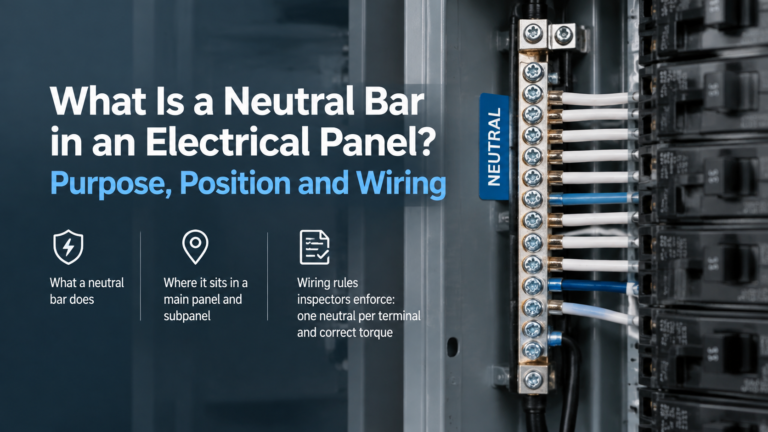
In a typical distribution board, the main power supply enters the system through an incoming breaker or switch. The busbar then distributes this power to several miniature circuit breakers, allowing each outgoing circuit to receive electrical current.
This design helps simplify the wiring structure inside the panel. Instead of using many separate jumper wires, one busbar can connect multiple MCBs in a straight and efficient layout.
A properly selected busbar can help provide:
- Stable current transmission
- Efficient power distribution
- Reduced wiring complexity
- Cleaner panel installation
- Better space utilization
- Reliable electrical contact
Because of these advantages, busbars are widely used in residential, commercial, and industrial low-voltage electrical systems.
How Does an MCB Busbar Work?
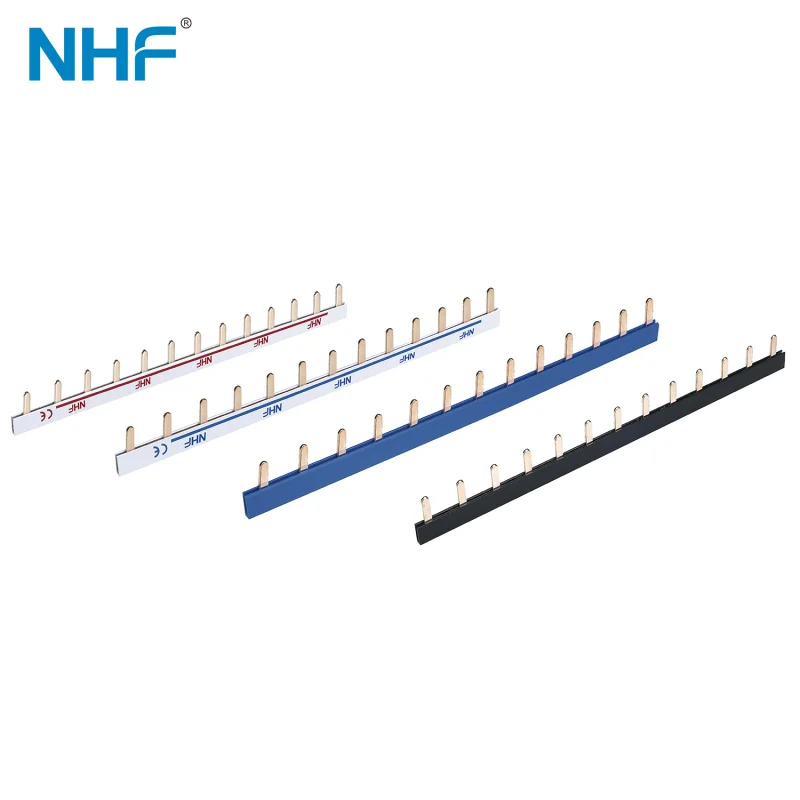
An MCB busbar is specially designed to connect multiple miniature circuit breakers inside a distribution board. It is usually installed across a row of MCBs, with each pin or fork terminal inserted into or connected with the breaker terminals.
When power enters the busbar, the conductive metal body carries the current along the entire length of the bar. Each connected circuit breaker then receives current through its contact point.
This structure allows power to be distributed evenly and efficiently to multiple outgoing circuits.
For example, in a single-phase distribution board, a one-pole busbar can connect several single-pole MCBs. In a three-phase system, a three-pole or four-pole busbar may be used to distribute power across different phases.
The exact busbar type depends on the circuit breaker design, pole number, current rating, and panel structure.
Main Types of Busbars for Distribution Boards
Different electrical panels require different busbar designs. For MCB connection and low-voltage distribution systems, the most common types include pin type busbars, fork type busbars, and C45 type busbars.
Pin Type Busbar
A pin type busbar uses straight pin terminals to connect with MCBs. The pins are inserted directly into the circuit breaker terminals, creating a simple and reliable electrical connection.
Pin type busbars are commonly used in modular distribution boards and low-voltage electrical panels. They are suitable for applications where the MCB terminal design accepts pin-style connection.
Common features of pin type busbars include:
Simple installation
Compact structure
Good electrical conductivity
Suitable for multiple MCB connections
Available in different pole configurations
Pin type busbars are often used in residential distribution boxes, commercial electrical panels, and OEM electrical equipment.
Fork Type Busbar
A fork type busbar has fork-shaped terminals that are connected under the screw terminals of circuit breakers. This design provides a firm mechanical connection and a wide contact area.
Fork type busbars are widely used in distribution boards and control panels where stable contact and secure fastening are important. The fork structure allows the busbar to be fixed tightly with the breaker terminal screw.
Common features of fork type busbars include:
Strong terminal connection
Easy installation and maintenance
Stable current transmission
Suitable for screw-type MCB terminals
Widely used in low-voltage panels
For many panel builders and installers, fork type busbars are a practical solution for clean and reliable MCB wiring.
C45 Type Busbar
C45 type busbars are designed for C45-style miniature circuit breakers and modular distribution systems. They help connect multiple C45 circuit breakers in a neat and efficient arrangement.
C45 busbars are commonly used in standard distribution boxes, control cabinets, electrical panels, and power distribution equipment. They are suitable for applications where compact wiring and fast installation are required.
Common features of C45 type busbars include:
- Designed for C45 MCB connection
- Suitable for modular electrical panels
- Clean and organized wiring layout
- Available in different lengths and pole numbers
- Practical for low-voltage distribution systems
For electrical panel assembly, C45 busbars help reduce wiring time and improve the internal structure of the distribution board.
Common Busbar Materials
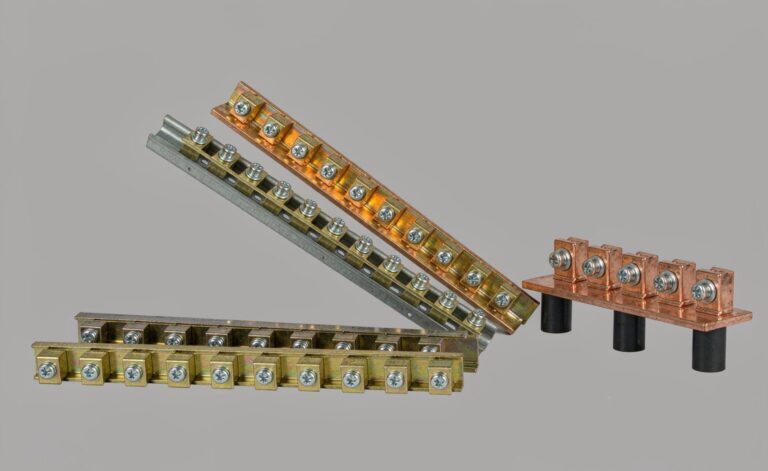
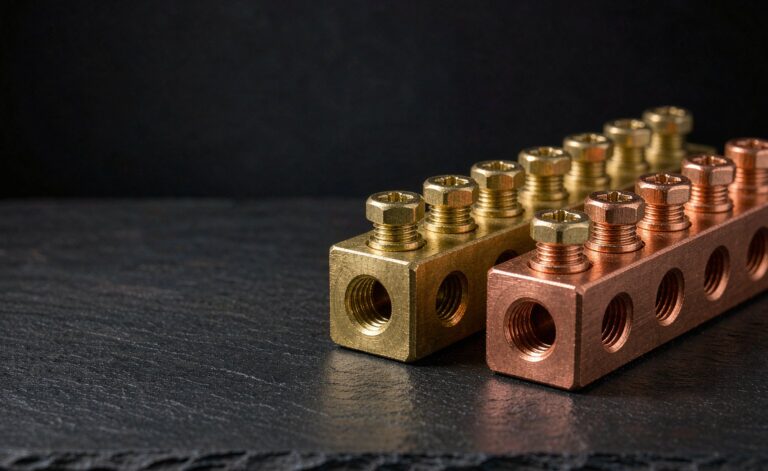
Busbars are usually made from high-conductivity metal materials such as copper, brass, or aluminum. For low-voltage MCB busbars, copper and brass are commonly used because they provide good electrical conductivity, mechanical strength, and stable performance.
The material selection can affect several important factors, including current-carrying capacity, temperature rise, mechanical durability, and long-term reliability.
Copper busbars generally offer excellent conductivity and are widely used in electrical distribution applications. Brass busbars also provide good conductivity and mechanical strength, making them suitable for many MCB connection products.
Some busbars are covered with insulation to improve safety and reduce the risk of accidental contact. Insulated busbars are especially useful in compact distribution boards where multiple conductive parts are installed close to each other.
Why Use a Busbar Instead of Cable Wiring?
Traditional cable wiring can be effective, but it may become complicated when many circuit breakers need to be connected. In a distribution board with multiple outgoing circuits, using separate wires for each connection can take more time and space.
A busbar offers a more efficient solution.
First, it reduces wiring work. One busbar can connect several MCBs at the same time, which helps save installation time.
Second, it improves panel appearance. The internal structure of the distribution board becomes cleaner and easier to inspect.
Third, it supports stable power distribution. A metal conductive strip provides a consistent current path between the incoming supply and outgoing circuits.
Fourth, it saves space inside the panel. Busbars are compact and suitable for modular electrical systems.
Finally, it can reduce wiring errors. With fewer individual wires, the installation process becomes simpler and more standardized.
For these reasons, busbars are widely used by electrical installers, panel builders, equipment manufacturers, and electrical distributors.
Important Factors When Choosing a Busbar
Choosing the right busbar is important for safe and reliable power distribution. Before selecting a product, buyers should consider the following factors.
1. Circuit Breaker Type
The busbar must match the terminal structure of the circuit breaker. Some MCBs are suitable for pin type busbars, while others require fork type busbars.
Using the wrong busbar type may lead to poor contact, difficult installation, or unstable electrical performance.
2. Number of Poles
Busbars are available in different pole configurations, such as 1P, 2P, 3P, and 4P. The correct pole number depends on the electrical distribution system.
For single-phase systems, a 1P or 2P busbar may be used. For three-phase systems, 3P or 4P busbars are commonly required.
3. Current Rating
The current rating of the busbar must meet the requirements of the electrical system. A busbar with insufficient current capacity may cause overheating or performance problems.
Common low-voltage busbar ratings may vary depending on the material, cross-section, thickness, and product design.
4. Length and Number of Ways
Different distribution boards require different busbar lengths. Some projects may need 6-way, 12-way, or 13-way busbars, while others may require customized lengths.
The number of ways should match the number of circuit breakers in the panel.
5. Insulation Design
Insulated busbars help improve safety by covering the conductive metal body. This reduces the chance of accidental contact and makes the panel safer during installation and maintenance.
For compact electrical panels, insulation is an important consideration.
During operation, current passing through the busbar generates heat. A good busbar should have proper material thickness, reliable contact points, and suitable current capacity to control temperature rise.
Poor contact or undersized busbars may increase resistance, causing heat buildup and reducing system reliability.
7. Customization Requirements
Some OEM projects or special electrical panels may require customized busbar dimensions, hole spacing, terminal style, insulation color, packaging, or current rating.
A professional busbar supplier should be able to provide both standard and customized solutions according to project requirements.
Applications of MCB Busbars
MCB busbars are used in many low-voltage power distribution applications, including:
- Distribution boards
- Consumer units
- Control panels
- Electrical cabinets
- Power distribution boxes
- Switchgear systems
- Industrial equipment panels
- Commercial electrical installations
- Residential electrical systems
- OEM electrical equipment
In these systems, busbars help distribute electrical power safely and efficiently while reducing the complexity of internal wiring.
Why Choose Naihang Electric Busbars?
Naihang Electric supplies busbar products for efficient power distribution and stable current transmission in electrical and industrial systems.
Our main busbar products include:
- Pin type busbar
- Fork type busbar
- C45 type busbar
- MCB busbar
- Distribution board busbar
- Customized busbar solutions
Our busbars are designed for low-voltage electrical panels, distribution boxes, control cabinets, and MCB connection systems. They are suitable for electrical installers, panel builders, distributors, and OEM equipment manufacturers.
We can provide different specifications according to customer requirements, including pole number, length, current rating, terminal type, insulation design, and packaging.
With reliable conductivity, convenient installation, and flexible customization, Naihang Electric busbars are practical solutions for modern low-voltage power distribution systems.
Conclusion
A busbar is an important component in electrical distribution systems. It helps distribute current from one power source to multiple circuits, making wiring cleaner, installation faster, and power transmission more stable.
For distribution boards and MCB connection systems, pin type busbars, fork type busbars, and C45 type busbars are widely used because they provide compact structure, reliable contact, and efficient current distribution.
When choosing a busbar, it is important to consider the circuit breaker type, pole number, current rating, length, insulation, contact quality, and customization needs.
If you are looking for a reliable busbar supplier for distribution boards, control panels, or OEM electrical equipment, Naihang Electric can provide standard and customized busbar solutions for your project.
FAQ
What is a busbar used for?
A busbar is used to distribute electrical power from one source to multiple circuits. In distribution boards, it is commonly used to connect multiple MCBs and simplify wiring.
What is an MCB busbar?
An MCB busbar is a conductive strip designed to connect miniature circuit breakers in a distribution board. It allows current to be distributed efficiently across several breakers.
What is the difference between pin type and fork type busbars?
A pin type busbar uses straight pins that insert into breaker terminals. A fork type busbar uses fork-shaped terminals that are fixed under breaker screws. The right choice depends on the terminal design of the circuit breaker.
What materials are used for busbars?
Busbars are commonly made from copper, brass, or aluminum. For MCB busbars, copper and brass are widely used because of their conductivity and mechanical strength.
Can busbars be customized?
Yes. Busbars can be customized by length, pole number, current rating, terminal type, insulation design, and packaging according to different project requirements.