Neutral Bar vs Ground Bar
Neutral bars and ground bars may look similar inside an electrical panel. Both are conductive terminal assemblies. Both may use brass or copper bars. Both can be supplied with multiple screw terminals, insulated bases, or DIN rail mounting options.
However, they do not perform the same function.
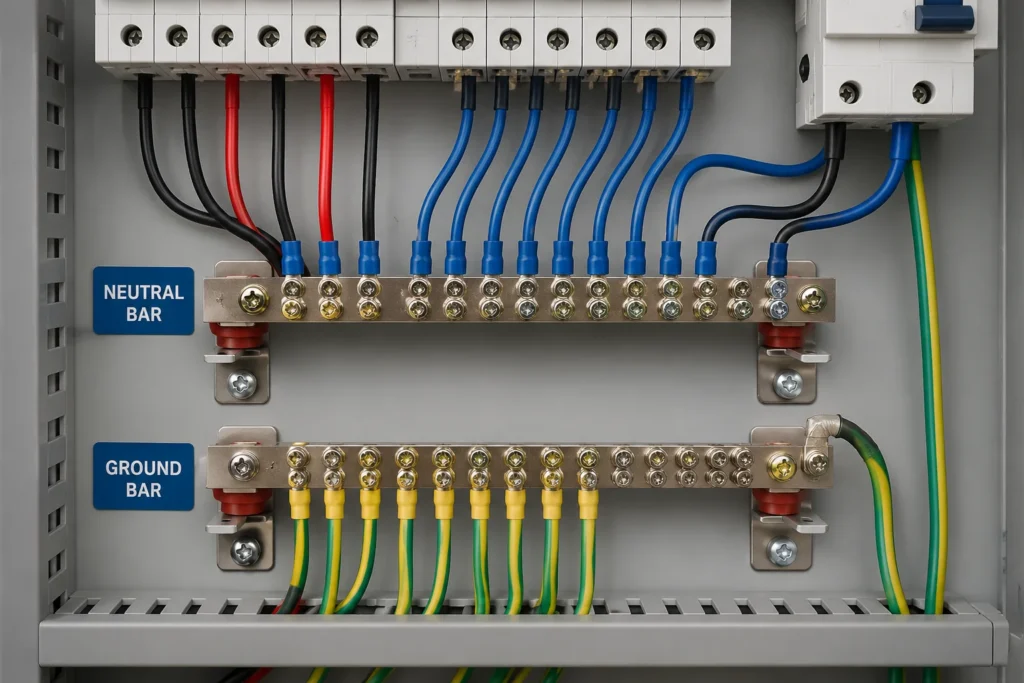
A neutral bar is used to collect neutral conductors and provide a controlled return-current path. A ground bar, also called an earth bar or PE bar, is used to connect protective earth conductors, enclosure bonding conductors, and other protective grounding connections.
For panel builders, OEM equipment manufacturers, electrical distributors, and procurement teams, choosing the wrong bar or mixing the two functions can create avoidable installation problems, maintenance difficulties, and safety risks. This guide explains the key difference between neutral bars and ground bars, where each is used, and how to select the correct terminal bar for an electrical panel.
Important: Final wiring, bonding, and protection arrangements must always follow the applicable local electrical code, panel design, equipment instructions, and project drawings.
Neutral Bar vs Ground Bar at a Glance
| Comparison Item | Neutral Bar | Ground Bar / Earth Bar |
|---|---|---|
| Primary function | Connects neutral conductors | Connects protective earth conductors |
| Normal operating current | Can carry normal return current | Normally does not carry load current |
| Common markings | N, Neutral, Neutral Bar | PE, Earth, Ground, GND |
| Typical conductor role | Current-carrying return conductor | Protective bonding and fault-current path |
| Typical installation | Insulated from the enclosure where required | Bonded to the metal enclosure where required |
| Common identification color | Blue insulation or N marking | Green, green-yellow, or PE marking |
| Key selection factors | Current capacity, conductor size, insulation, terminal count | Grounding design, enclosure bonding, terminal capacity, mounting method |
The simplest way to understand the difference is this:
- A neutral bar belongs to the normal operating circuit.
- A ground bar belongs to the protective earthing system.
Both require reliable electrical connections, suitable conductor capacity, correct terminal spacing, and secure mounting. But they must not be treated as interchangeable components.

What Is a Neutral Bar?
A neutral bar is a conductive terminal assembly used to connect the neutral conductors of multiple circuits inside a distribution board, electrical enclosure, switchgear assembly, or industrial control panel.
In many AC electrical systems, the neutral conductor provides the return path for current flowing from connected loads. For this reason, a neutral bar may carry normal operating current during everyday use.
Neutral bars are commonly used in:
- Low-voltage distribution boards
- Industrial control panels
- Commercial electrical cabinets
- Machine control systems
- Modular electrical enclosures
- OEM power distribution equipment
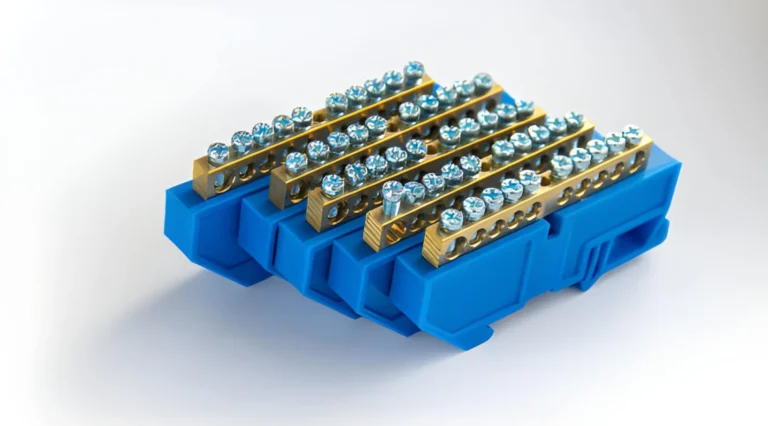
A neutral bar may be identified by an “N” marking, blue insulated base, blue terminal cover, or neutral conductor labeling. Identification standards vary by region, but clear marking is important for installation, maintenance, and fault diagnosis.
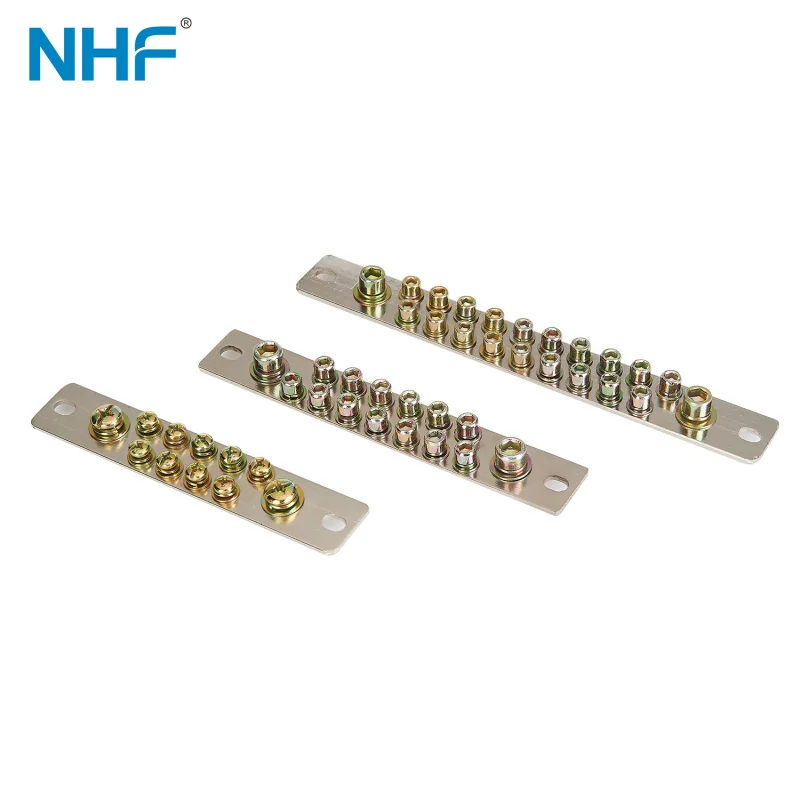
When selecting a neutral bar, buyers should not focus only on the number of terminals. They should also confirm the conductor material, terminal screw size, mounting style, available installation space, insulation requirement, and compatibility with the panel design.
For example, a compact panel may require a DIN rail neutral bar with an insulated holder, while a larger distribution board may require a panel-mounted neutral bar with a higher terminal count.
What Is a Ground Bar or Earth Bar?
A ground bar is used to connect protective earth conductors and bonding conductors within an electrical panel or enclosure. It may also be called an earth bar, grounding bar, PE bar, or equipment grounding bar depending on the market and electrical standard.
The ground bar is part of the protective earthing system. Its main purpose is not to carry normal load current. Instead, it provides a reliable protective connection for exposed conductive parts and fault-current paths.
Typical connections to a ground bar may include:
- Protective earth conductors
- Equipment grounding conductors
- Metal enclosure bonding conductors
- Cabinet door bonding straps
- Mounting plate bonding conductors
- Surge protective device earth leads
- Cable armor bonding conductors
- Metal frame grounding points
In a properly designed panel, the ground bar helps ensure that exposed metal parts remain connected to the protective earthing system. During a fault condition, this path supports the intended operation of circuit protection devices and protective systems.
Ground bars are often identified by green or green-yellow insulation, PE marking, grounding symbols, or direct bonding to the metal enclosure where required by the system design.
Neutral Bar vs Earth Bar: Why the Difference Matters
Neutral bars and earth bars are both conductive components, but their electrical functions are fundamentally different.
A neutral bar is part of the current-carrying circuit. A ground bar is part of the protective system.
Using a ground bar as a neutral bar can cause normal return current to flow through protective conductors, metal enclosures, mounting structures, cable shielding, or other conductive parts that should not carry load current.
Using a neutral bar as a ground bar can create the opposite problem. It may result in an unsuitable protective connection, unclear maintenance identification, or an incorrect bonding arrangement.
For panel builders and electrical equipment manufacturers, the best practice is to separate the functions clearly:
- Use a dedicated neutral bar for neutral conductors.
- Use a dedicated ground bar or PE bar for protective earth conductors.
- Use clear labels and color coding.
- Select the correct insulation and mounting method for each bar.
- Follow the panel design and applicable electrical regulations.
This separation also makes electrical cabinets easier to inspect, troubleshoot, expand, and maintain.
Neutral and Ground in Main Panels and Downstream Panels
The relationship between neutral and ground can vary according to the electrical system, earthing arrangement, equipment type, and local regulations.
In some main service equipment or designated bonding locations, neutral and protective earth may be connected at a specified point according to the system design. However, in downstream distribution boards, subpanels, and many control-panel applications, neutral and protective earth are typically kept separate.
For example:
- The neutral bar may be insulated from the metal enclosure.
- The ground bar may be bonded to the enclosure.
- Neutral conductors may be terminated on the N bar.
- Protective earth conductors may be terminated on the PE bar.
This approach helps prevent unintended current paths through protective conductors or exposed metalwork.
For international projects, panel builders may work with TN-S, TN-C-S, TT, IT, or other earthing arrangements. The exact bonding method must be verified against the project specification and applicable standard. A neutral and ground bar should never be selected or installed based on appearance alone.
How to Choose the Right Neutral Bar or Ground Bar
Selecting a neutral bar or ground bar should be based on the full electrical and mechanical requirement of the panel, not only the product price.
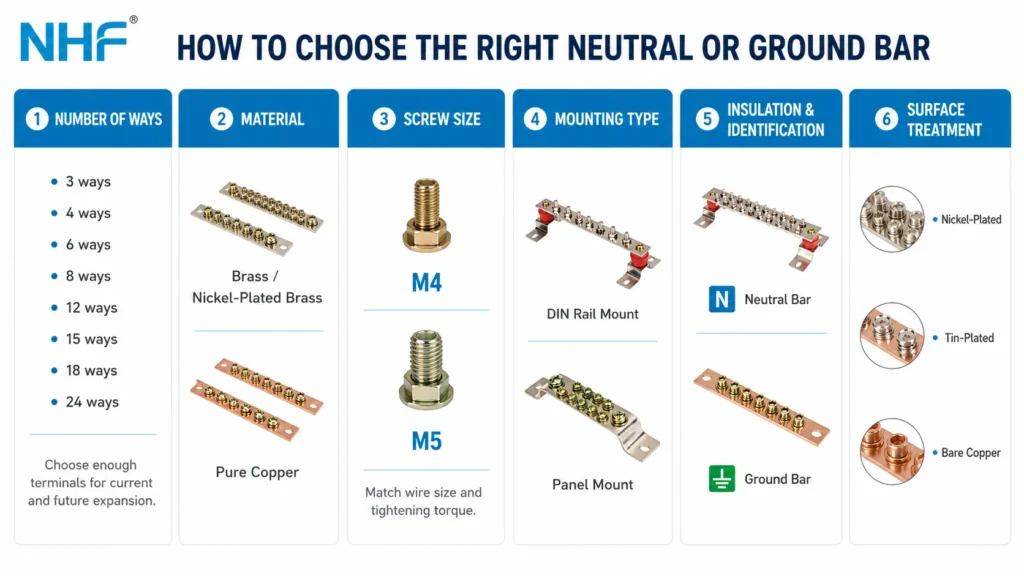
1. Choose the Correct Number of Ways
The number of terminals should match the number of conductors that need to be connected, while leaving room for future expansion where practical.
Common configurations include:
- 3 ways
- 4 ways
- 6 ways
- 8 ways
- 10 ways
- 12 ways
- 15 ways
- 18 ways
- 24 ways
For small distribution boxes, a 3-way to 8-way neutral or earth bar may be sufficient. For larger control panels, switchgear assemblies, or OEM production lines, a 12-way, 15-way, or double-row terminal bar may offer better wiring organization.
A double-row neutral bar can be especially useful when multiple branch circuits must be arranged in a compact enclosure.
2. Select the Right Conductor Material
Neutral bars and ground bars are commonly made from brass, copper, or plated conductive materials.
Brass terminal bars are widely used because they offer good conductivity, mechanical strength, machining stability, and cost efficiency. Nickel-plated brass bars can provide additional surface protection in environments where oxidation resistance is important.
Pure copper bars are often selected when higher conductivity is required. They can be suitable for applications where electrical performance is the main priority.
When comparing materials, consider:
- Required current capacity
- Conductor size
- Installation environment
- Corrosion exposure
- Mechanical strength
- Cost target
- Customer specification
- OEM drawing requirements
For export projects, it is also important to confirm whether the buyer requires a particular plating finish, such as nickel plating or tin plating.
3. Confirm Terminal Screw Size and Wire Compatibility
Terminal screw size affects the clamping performance, installation convenience, and suitable conductor range.
Common screw sizes include:
- M4
- M5
- M6
M4 and M5 screw terminals are frequently used for brass neutral bars and grounding bars in distribution boards and control cabinets. The final selection should match the conductor cross-section, terminal design, installation torque, and panel specification.
Do not choose a terminal bar only by screw size. Confirm the complete combination of:
- Screw specification
- Thread quality
- Terminal hole size
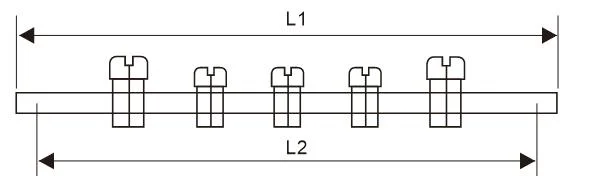
- Bar dimensions
- Suitable conductor range
- Recommended tightening torque
- Insulator clearance
- Available installation space
A loose connection can increase contact resistance and generate heat. An incorrectly sized terminal may make installation difficult or damage the conductor.
4. Choose DIN Rail Mount or Panel Mount
Mounting method is one of the most important practical differences between terminal bar designs.
DIN Rail Mounted Neutral and Ground Bars
DIN rail mounted bars are suitable for modular control cabinets, compact electrical panels, and standardized enclosure layouts. They can simplify assembly and replacement, especially where components are arranged on 35 mm DIN rails.
Benefits include:
- Faster installation
- Modular panel layout
- Easier maintenance
- Cleaner cable routing
- Better suitability for standardized control cabinets
Panel Mounted Neutral and Ground Bars
Panel mounted bars are fixed directly to the enclosure backplate, chassis, or mounting surface. They are often used in larger distribution boards, switchgear panels, and applications requiring a more permanent installation.
Benefits include:
- Stable mechanical fixing
- Flexible installation position
- Suitable for larger terminal bars
- Easier adaptation to custom enclosure layouts
- Suitable for OEM panel designs
Before ordering, confirm the mounting hole spacing, rail compatibility, base dimensions, screw-hole position, and clearance around the terminal area.
5. Check Insulation and Identification Requirements
Neutral bars and ground bars should be easy to identify during installation and maintenance.
For neutral bars, buyers may require:
- Blue insulated base
- N marking
- Neutral label
- Insulated mounting support
- Clear separation from the metal enclosure where required
For ground bars, buyers may require:
- Green or green-yellow insulated base
- PE marking
- Earth symbol marking
- Direct enclosure bonding method
- Grounding strap connection points
Color-coded insulation helps reduce wiring errors and improves maintenance efficiency. It is especially useful for OEM equipment, control-panel production, and export projects where technicians need to identify circuit functions quickly.
6. Consider Surface Treatment and Corrosion Resistance
Electrical panels may operate in humid, industrial, coastal, or high-temperature environments. Surface treatment can improve the long-term stability of terminal bars.
Common options include:
- Nickel-plated brass
- Tin-plated brass
- Bare brass
- Pure copper with protective finish
Nickel plating can help improve oxidation resistance and create a cleaner appearance for industrial and export equipment. Tin plating may be selected where the project requires improved solderability or specific corrosion performance.
The correct treatment depends on the intended application environment and customer specification.
Typical Applications for Neutral Bars and Ground Bars
Neutral bars and ground bars are used across many electrical connection systems.
Electrical Distribution Boards
In distribution boxes, neutral bars collect neutral conductors from branch circuits, while ground bars connect protective earth conductors and enclosure bonding points.
Industrial Control Panels
Control cabinets often require compact, clearly identified terminal bars for power distribution, machine wiring, protective grounding, and maintenance access.
Switchgear Assemblies
Larger switchgear systems may use higher-capacity neutral and earth bars with custom mounting dimensions, higher terminal counts, and specific conductor arrangements.
OEM Electrical Equipment
OEM manufacturers may require customized neutral and grounding bars for electrical equipment, automation systems, power control units, HVAC equipment, lighting systems, or industrial machinery.
Renewable Energy and Power Systems
Neutral bars and PE bars can also be used in solar combiner boxes, inverter cabinets, battery-related systems, and other low-voltage power distribution assemblies, depending on the project design.
OEM Custom Options for Neutral and Ground Bars
For distributors, panel builders, and OEM customers, standard terminal bars are not always enough. A supplier should be able to support practical customization requirements.
Common OEM options include:
- Custom terminal way count
- Custom bar length
- Custom hole spacing
- Custom mounting-hole pattern
- M4, M5, or other screw options
- Brass or copper conductor bars
- Nickel-plated or tin-plated surface finish
- Blue, green, or custom insulation colors
- DIN rail mounting version
- Panel-mounted version
- Custom labels or laser marking
- Private-label packaging
- Bulk carton packaging
- Export labeling
For example, a distributor may require a standard 12-way brass neutral bar with blue insulation and retail packaging, while an OEM control-panel manufacturer may need a custom-length grounding bar with specific mounting holes and green insulation.
Providing a clear technical drawing, required way count, conductor size, mounting dimensions, and expected order quantity will help the supplier recommend the correct solution.
Common Mistakes When Selecting Neutral and Ground Bars
Choosing Only by Appearance
Neutral bars and ground bars can look almost identical. Always confirm the intended electrical function, insulation requirement, and mounting method.
Ignoring the Number of Ways
A terminal bar with too few positions may lead to overcrowded wiring or unnecessary terminal sharing. Select enough ways for the current circuit design and reasonable future expansion.
Using the Wrong Mounting Method
A DIN rail bar may not fit a panel designed for direct mounting, while a panel-mounted bar may complicate a modular control cabinet layout. Check installation dimensions before ordering.
Forgetting About Wire Size and Screw Size
Terminal screw size and conductor range must be compatible. A bar that appears suitable may not provide the required clamping performance for the installed wire size.
Mixing Neutral and PE Conductors Without Clear Identification
Clear N and PE labeling, color-coded insulation, and separate terminal bars make troubleshooting and maintenance much safer and faster.
Overlooking Environmental Conditions
For humid, corrosive, or industrial environments, surface treatment and insulation material should be considered as part of the product selection.
Choose the Right Neutral and Grounding Bar for Your Panel
The right neutral bar or ground bar improves wiring organization, installation efficiency, maintenance access, and long-term electrical reliability.
When sourcing neutral and grounding bars, confirm the way count, conductor material, screw size, mounting style, insulation color, surface treatment, and custom requirements before placing an order.
NHF electric supplies brass and copper neutral bars, grounding bars, double-row terminal bars, insulated terminal bars, and customizable electrical connection solutions for distribution boards, control panels, and OEM electrical equipment.
Contact our team with your required terminal count, installation dimensions, material preference, and project application to receive a suitable product recommendation and quotation.
FAQ
What is the difference between a neutral bar and a ground bar?
A neutral bar connects neutral conductors and can carry normal return current. A ground bar connects protective earth conductors and is intended for safety grounding and fault-current paths.
Can a ground bar be used as a neutral bar?
No. A ground bar should not be used as a normal neutral return path. Neutral and protective earth conductors serve different functions and should be connected according to the panel design and applicable electrical requirements.
Is an earth bar the same as a ground bar?
In many international electrical systems, yes. “Earth bar,” “ground bar,” and “PE bar” generally describe the terminal bar used for protective earth conductors.
Does a neutral bar need an insulated base?
In many downstream panels and distribution boards, the neutral bar is mounted on an insulated base so it remains separated from the metal enclosure where required by the system design.
Which material is better for a neutral bar: brass or copper?
Both materials can be suitable. Brass offers good mechanical strength and cost efficiency, while pure copper provides higher conductivity. The correct choice depends on current requirements, environmental conditions, design specifications, and budget.
Can neutral bars and ground bars be mounted on DIN rails?
Yes. DIN rail mounted neutral and ground bars are commonly used in modular distribution boards and industrial control cabinets. Confirm the rail type, mounting dimensions, and terminal configuration before ordering.
How do I choose the right number of terminals?
Count the neutral or protective earth conductors that need to be connected, then select a bar with enough terminals for the current design and reasonable future expansion.