Why Is My MCB Busbar Overheating? Causes and Fixes
MCB busbar overheating usually comes from loose contacts, overload, or the wrong busbar type. Learn the causes, how to diagnose, and how to fix it safely.
Read More
Every distribution board faces the same question: how do you feed a row of MCBs from one supply? Two methods dominate: a comb busbar, a prefabricated insulated bar that plugs into every breaker at once, and jumper wires, short conductors linked from one MCB to the next. Use a comb busbar for a continuous row of compatible MCBs — it is faster, cleaner, and gives every terminal a consistent single contact. Use jumper wires when the row is mixed, interrupted, or being retrofitted, where no single busbar fits every device. This guide compares both across speed, reliability, cost, and layout, and explains when they work together.
Two questions decide it:
A comb busbar wins on installation time, appearance, and contact consistency; jumper wire wins on flexibility for mixed or non-standard layouts. Neither is universally better — the device row and the manufacturer’s documentation decide.
A comb busbar is a pre-insulated copper bar with repeated pins or fork teeth that align with the terminals of modular devices. It connects a whole row of MCBs to one supply in a single step, and it is manufactured for specific pole configurations: 1P, 2P, 3P, 4P, and 1P+N or 3P+N patterns.
Key characteristics:
A jumper wire connection links the supply side of adjacent MCBs with short insulated conductors. Each jumper is cut, stripped, bent, and terminated individually, either from the same feed terminal to each breaker or in a daisy chain from one to the next. (This is the panel-wiring jumper, distinct from the bridging links used on terminal blocks in control cabinets, which our terminal block jumper guide covers.)
Key characteristics:
Here is the comparison that matters when you are wiring a panel:
| Aspect | Comb Busbar | Jumper Wire |
|---|---|---|
| Installation speed | Fast; one part connects the whole row | Slow; each jumper is cut, stripped, and bent by hand |
| Contact consistency | One factory-made tooth per terminal | Two wire ends share each terminal, quality depends on workmanship |
| Appearance and space | Neat, compact, uniform | Messier; more wire and bend space consumed |
| Current rating | Published per model, defined cross-section | Depends on wire size chosen; must cover downstream total |
| Flexibility | Limited to the documented device series and pitch | Adapts to mixed devices, heights, and reserved spaces |
| Mixed or retrofit rows | Usually unsuitable without approved adapters | Often the practical choice |
| Device replacement | May require loosening the whole bar | Individual jumpers can be undone separately |
| Material cost | Higher per panel; accessories included | Lower, wire plus ferrules |
| Repeatability | Identical across production batches | Varies with each installer |
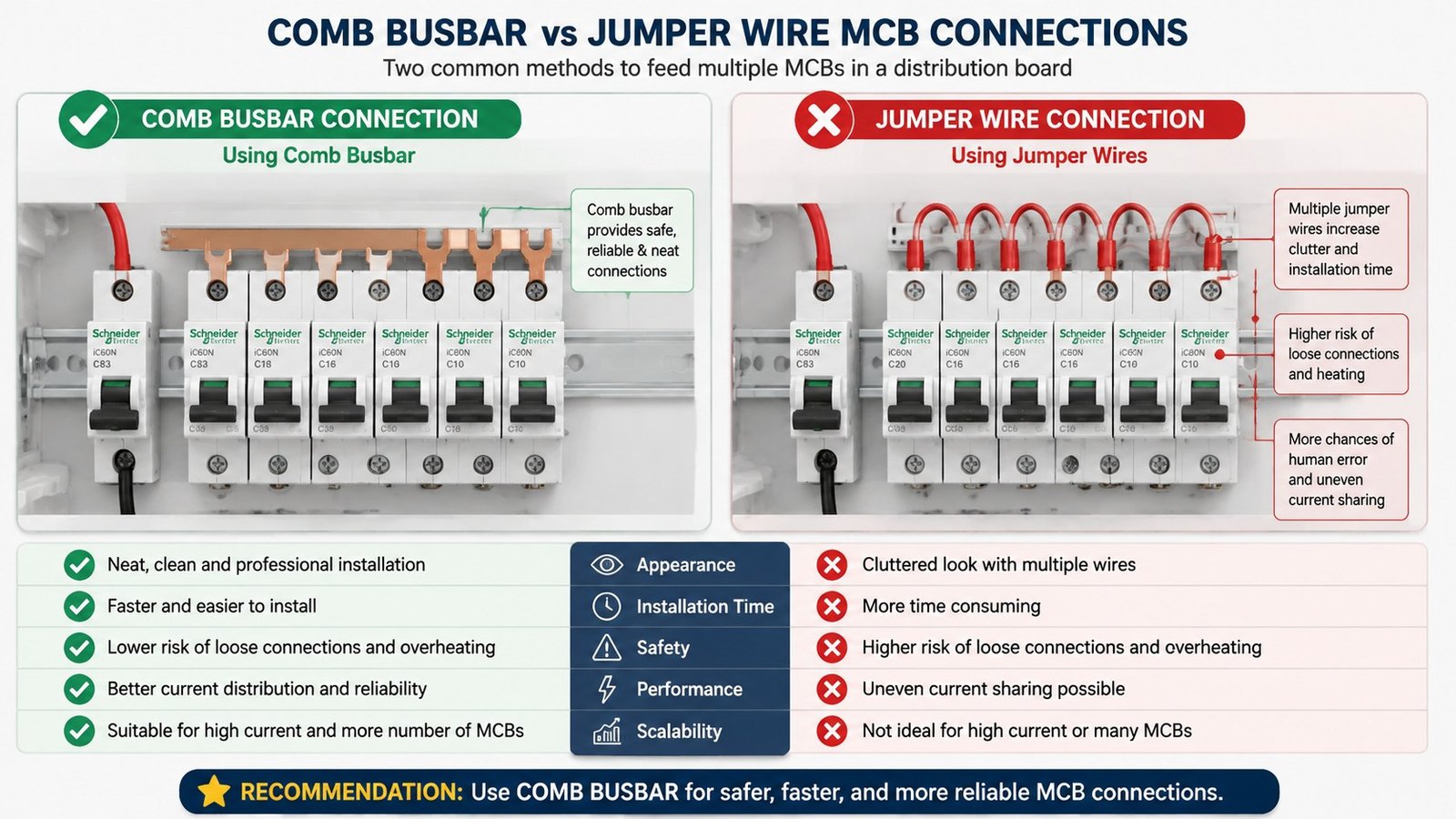
Choose a comb busbar when the row is uniform and the busbar is documented for every device in it:
Before ordering, confirm the busbar matches the breaker series, pin or fork type, pitch, and pole sequence — the MCB busbar compatibility guide walks through those checks, and the pin-type vs fork-type busbar comparison explains the contact geometries.
Use jumper wire when the layout breaks the conditions a comb busbar needs:
Size every jumper section for the total current downstream of it, and terminate with ferrules on flexible wire. Quality depends on the installer, so inspect each connection.

Yes, in a controlled way. A common pattern is to split a mixed row into uniform groups: a comb busbar for each group of identical MCBs, with jumper wires or an approved transition connecting the groups across an incompatible device or a reserved space. This keeps the repetition benefits of the comb inside each group without forcing one bar across an interruption.
The key rule from the standards is that a tidy physical fit is not enough. Each connection — busbar tooth or jumper — must be approved for the specific device terminal, carry the correct current, and be documented. If a row is mixed enough that neither a single comb nor a handful of jumpers cleanly covers it, review the layout with the manufacturer before energizing.
Poorly executed jumpers are a known overheating source; our MCB busbar overheating guide explains why loose or crowded connections run hot.
For a continuous row of compatible MCBs, a matched comb busbar is usually faster, neater, and more repeatable. Jumper wire is more adaptable for mixed or interrupted layouts. The device documentation and the current path decide which is correct.
Yes, when the row is mixed, short, or retrofitted, and the wire size covers the downstream current with properly terminated connections. Avoid it in panels designed around a busbar system.
It depends on the cross-section and model; a common 16 mm² comb is rated around 63 A. Check the published rating for the specific part.
Yes, by splitting the row into uniform groups with a comb per group and jumper wires or approved transitions between groups.
No. A comb busbar distributes power across MCBs in a distribution board; a terminal block jumper bridges terminals in a control-cabinet terminal row. They serve different panels and are not interchangeable.
Yes. Every cut end and unused tooth must be finished with insulating end caps and tooth covers for touch safety.
The choice between a comb busbar and jumper wire comes down to the shape of the row: a comb busbar for a continuous, documented row of compatible MCBs — faster, neater, and more consistent; jumper wires for mixed, interrupted, or retrofitted layouts where flexibility matters more. Many panels combine both, with a comb per uniform group and jumpers bridging the interruptions. Match the method to the devices, size every conductor for the downstream total, and protect every cut end. For a matched comb busbar, browse the busbar range or contact the manufacturer with your breaker lineup to confirm the right part.