Comb Busbar vs Jumper Wire: Which Is Better for MCB Panels?
Comb busbars feed a row of MCBs cleanly with consistent contact; jumper wires work for mixed or modified panels. Compare speed, reliability, cost, and when to use each.
Read More
If you build or maintain electrical panels, you have probably stared at a distribution block and a terminal block side by side and wondered whether they do the same job. They look similar, but they are built for different tasks. A power distribution block takes one high-current input and splits it into multiple output circuits through an internal busbar; a terminal block connects and organizes individual wires point to point, keeping each circuit isolated. Choosing the wrong one can mean an overloaded connection, an unsafe panel, or unnecessary rework. This guide compares both components across function, ratings, wiring, applications, and standards so you can pick the right one for your project.
The short version: a power distribution block is a power-splitting device. It accepts one large feeder conductor on the line side and distributes it to several smaller branch circuits on the load side through a common internal copper busbar. A terminal block is a wiring termination point. It connects one conductor to another, or to a device, with each terminal position electrically isolated from its neighbors.
Think of it this way: the distribution block is the power hub that feeds multiple loads from one source, while the terminal block is the organized connection point for control, signal, and lower-current wiring inside the cabinet.
A power distribution block is a compact, busbar-based component that centralizes power distribution inside an enclosure. It has one input termination (or a small number of inputs) rated for a large conductor and multiple output terminations rated for smaller branch wires. All outputs are connected to the same internal conductive bar, so every branch circuit draws power directly from the source in parallel rather than through a daisy chain.
Typical characteristics:
Distribution blocks are the standard solution when a single large feed, such as a main incoming conductor, a battery bank, or a solar DC bus, must power several sub-circuits or loads at once. For a deeper look at selection criteria, see our power distribution block selection guide.
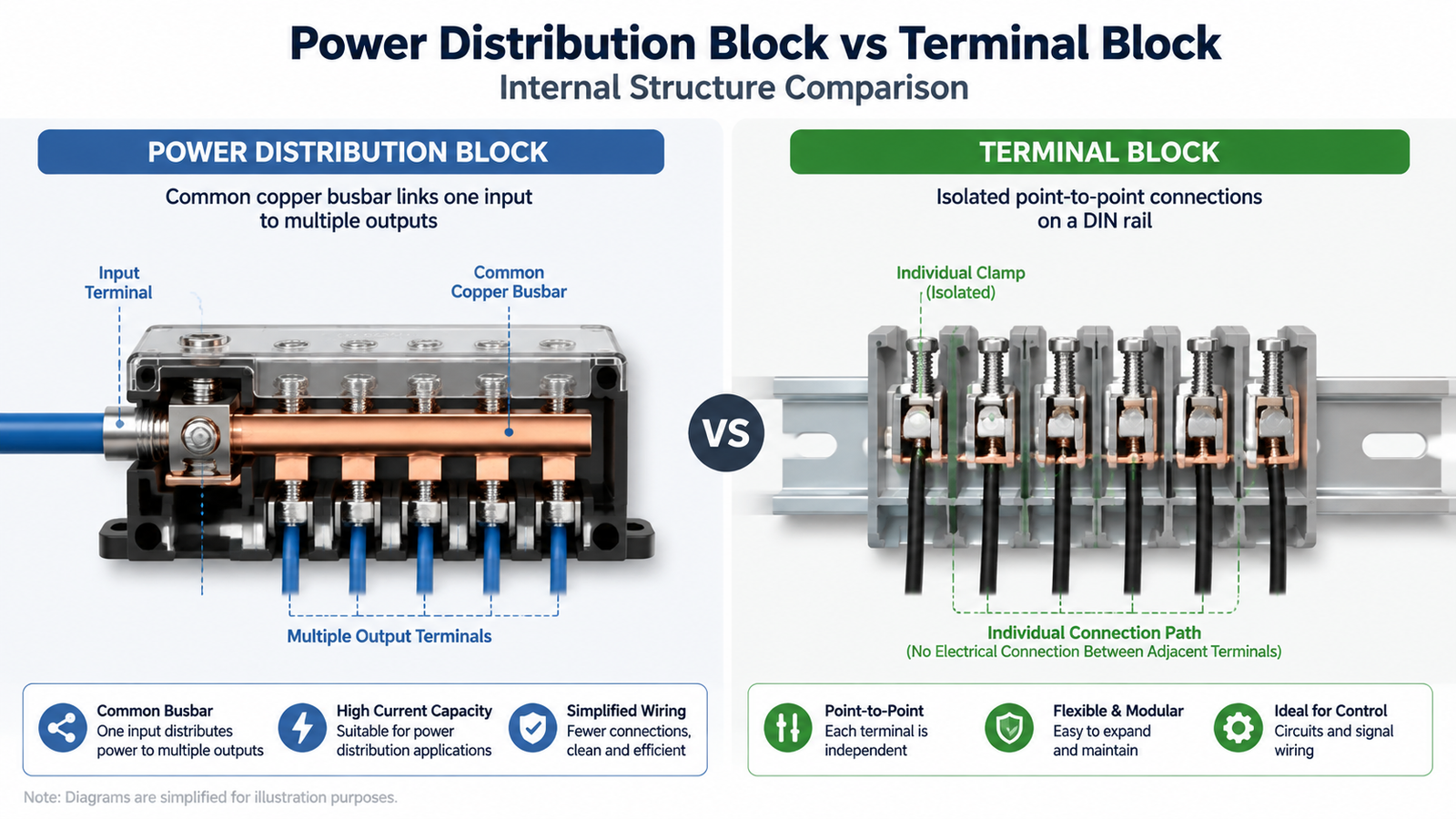
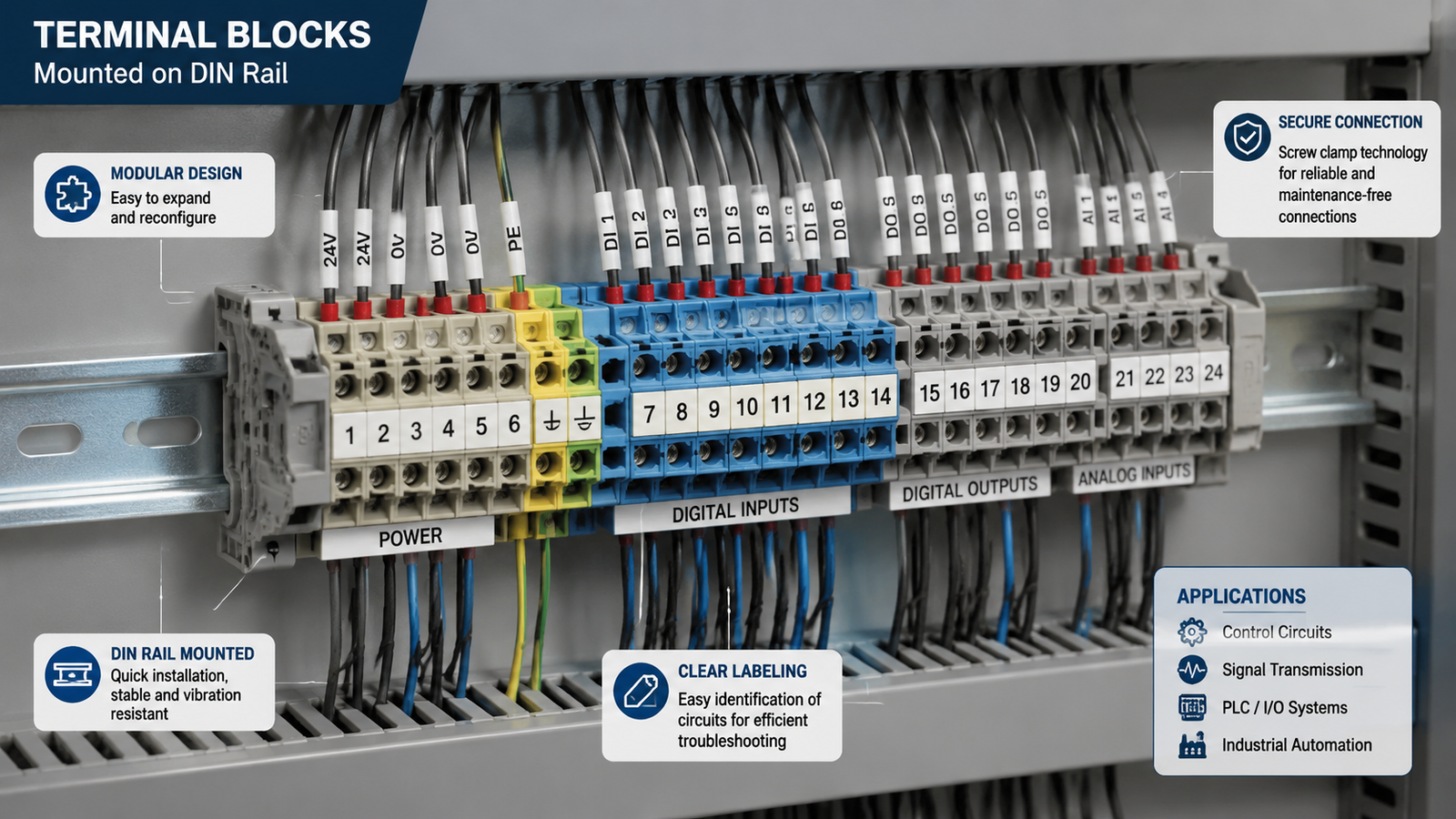
A terminal block is a modular, insulated connector that terminates and organizes individual wires. Each terminal position provides a secure, clamp-style connection (screw, spring cage, or push-in) for one incoming and one outgoing conductor. Positions are isolated from each other, which means you can disconnect, test, or replace one circuit without affecting the others around it.
Key features:
Terminal blocks are the backbone of control panels, PLC I/O wiring, sensor and actuator circuits, and any place where many small conductors need a clean, labeled, and serviceable connection point. Our complete guide to DIN rail terminal blocks walks through the options in more detail.
Here is the side-by-side comparison that matters when you are choosing a component:
| Aspect | Power Distribution Block | Terminal Block |
|---|---|---|
| Primary function | Splits one power source into multiple branch circuits | Connects and terminates individual wires point to point |
| Internal structure | Common copper busbar linking one input to all outputs | Isolated conductive paths, one per terminal position |
| Typical current rating | High, commonly 100 A to 600 A or more | Lower, typically 6 A to 32 A for control duty, up to 150 A for power types |
| Typical wire sizes | Large input conductors, smaller output branches | Similar-gauge conductors, usually small to moderate |
| Typical application | Power distribution panels, main feeds, DC distribution, motor circuits | Control panels, PLC I/O, signal wiring, enclosures |
| Circuit isolation | Outputs share the same bus and are fed together | Each position isolated; one circuit can be serviced alone |
| Mounting | DIN rail or panel mounted | DIN rail mounted, modular and expandable |
| Common standards | UL 1059, IEC 60947-7-1 | IEC 60947-7-1, UL 1059 |
| Typical cost | Higher per unit, due to heavy-duty busbar construction | Lower per position |
The current and conductor ranges above are not arbitrary; they reflect how each component is built. A power distribution block uses a single solid busbar with large line-side lugs that accept conductors up to 250 kcmil (roughly 120 mm²) or more, depending on the model, so it can carry the full feeder current without overheating. Each output tap is sized for branch conductors, typically 14 AWG to 2 AWG (1.5 to 35 mm²).
Terminal blocks, by contrast, are designed around smaller conductors (commonly 24 AWG to 4 AWG / 0.2 to 25 mm² for general control blocks) and lower per-position currents. Trying to feed a 200 A panel through a row of 32 A terminal positions would daisy-chain multiple contacts, adding resistance at every junction. The first terminal would carry the full current and fail first.
When designing the distribution path of a panel, work from the source outward: use a distribution block (or a copper busbar for the highest current range) for the main feed, and step down to terminal blocks once you reach individual control and signal circuits.
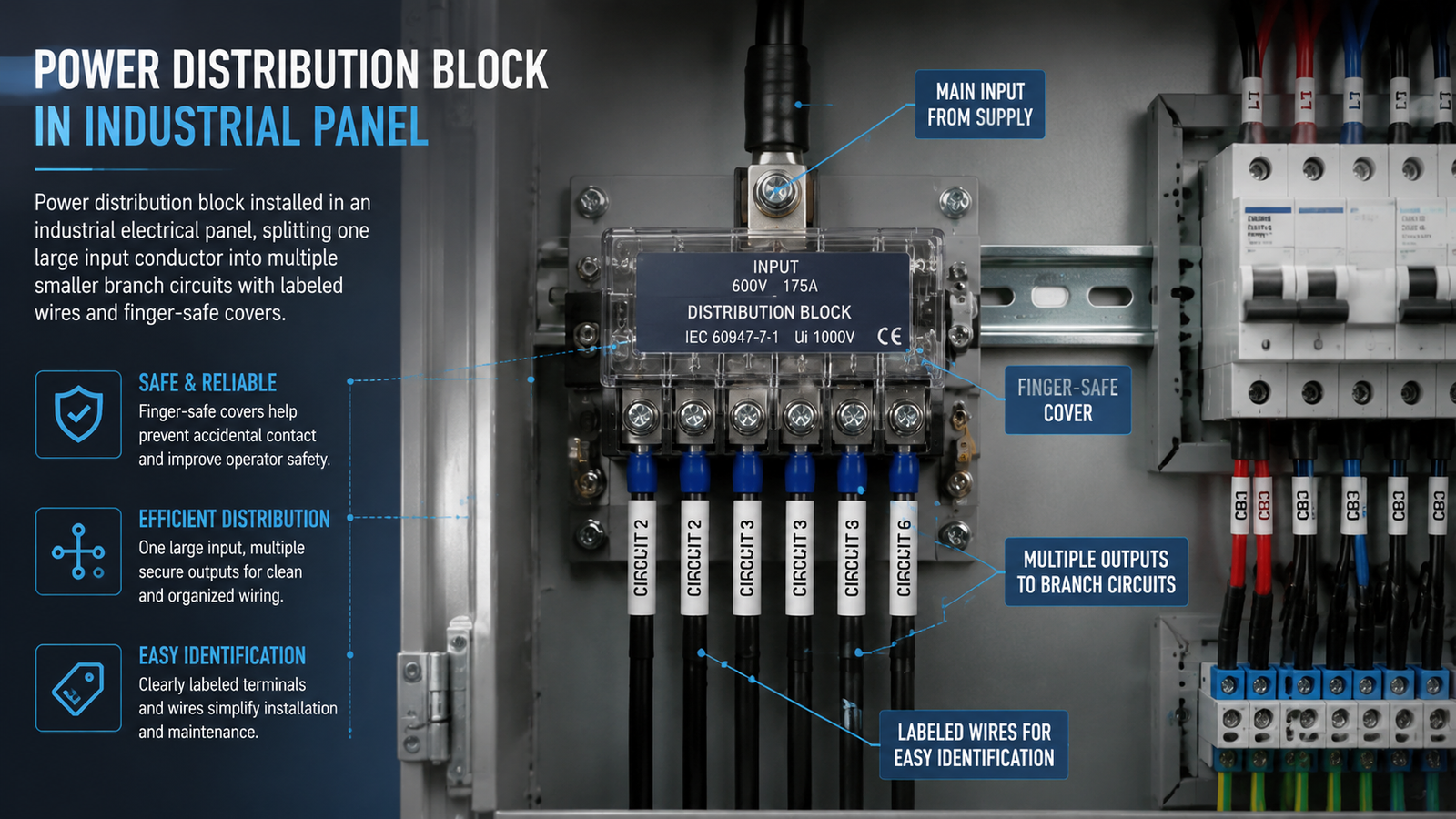
Choose a power distribution block whenever a single high-current feed has to reach several loads or sub-circuits. Common situations include:
Because all outputs connect to the bus in parallel, a distribution block also keeps voltage drop and heat lower than daisy-chaining connections through several individual terminals. For even higher current fan-out, some panel builders use a copper busbar instead of a distribution block; the two overlap at the top of the current range, which is why it is worth comparing both before you commit. Our installation guide covers torque values and safety practices for these blocks.
Use a terminal block when the job is wiring management and circuit organization rather than bulk power splitting. Typical cases:
If your circuit count is high but each circuit carries modest current, a terminal block strip is usually the more practical and economical choice. See our breakdown of terminal block types for electrical wiring for the full range.
In most cases, no. A terminal block connects two conductors to each other, but a single terminal position is not designed to fan one large conductor out to many branch circuits under high current. If you try to bridge several terminal positions in a row to distribute power, you create a daisy chain where every junction adds resistance, heat, and a potential failure point. Under sustained load, the first connection carries the full current and can overheat.
A power distribution block solves this with a solid busbar that gives every output a direct, low-resistance path to the source. One failed output does not interrupt the others, and the whole assembly is rated to carry the combined current safely. For high-amperage distribution, a purpose-built block is the only sound option.
You will also see hybrid components called power distribution terminal blocks, which combine the multi-output convenience of a distribution block with the modular DIN-rail footprint of a terminal block. They typically cover the middle of the current range, often from about 80 A up to around 400 A, and are useful when you want a single rail-mounted device that feeds several branch circuits without taking up dedicated panel space.
For example, Naihang’s four-phase distribution block series and the 160 A DIN-rail power distribution terminal block sit in this middle zone, offering multiple output positions per pole with transparent covers and finger-safe construction.
These hybrid blocks are not a substitute for either a full power distribution block or a control-grade terminal block; they fill the gap in between and are a sensible choice when panel space and current handling both matter.
Work through these five questions to narrow the decision:
When the answer points to power splitting, compare distribution blocks, busbars, and related components from your supplier to match ratings, poles, and mounting style to the panel design.
A power distribution block splits one high-current input into multiple output circuits through an internal busbar, while a terminal block connects and organizes individual wires point to point with each position isolated.
Only for low-current, low-circuit-count situations. For high-amperage power splitting, a terminal block daisy chain adds resistance and heat; a distribution block with a solid busbar is the safe choice.
Add the full-load current of every branch circuit and choose a block rated above that total, with a safety margin for inrush current and ambient temperature.
It depends on the number of poles, which typically ranges from 1 to 12. Choose a block with at least as many outputs as you need today, plus room for expansion.
Yes, when the block is explicitly rated for DC. Check the manufacturer’s voltage and current ratings for your DC bus before installing.
Both typically comply with IEC 60947-7-1 for low-voltage switchgear and controlgear assemblies, and many models are also certified to UL 1059 in North America. Always confirm the specific certifications on the product datasheet.
The rule is simple: split power with a distribution block, terminate wires with a terminal block. Distribution blocks handle high-current fan-out from one feed to many circuits with a low-resistance busbar; terminal blocks keep control and signal wiring clean, isolated, and serviceable. Hybrid power distribution terminal blocks fill the middle ground when both rail-mounting and multi-output splitting matter. Match the component to the current, circuit count, wire size, and standards of your panel, and you will avoid the most common failure points. If you are sourcing either component for a new panel design, browse the distribution block range or contact the manufacturer for help matching ratings and mounting to your application.