A Complete Guide to DIN Rail Terminal Blocks
Table of Contents
DIN rail terminal blocks are widely used in industrial control panels and electrical systems to organize, connect, and distribute wiring safely and efficiently.
In this guide, you will learn how DIN rail terminal blocks work, the main types and sizes, how to wire them correctly, and how to choose the right option for your application.
What are DIN Rail Terminal Blocks?
A DIN rail is a standardized metal strip used to mount electrical and industrial control devices inside cabinets or racks. It serves only as a physical support. It does not conduct electricity or create connections.
The term “DIN” comes from Deutsche Institut für Normung, the German standards body. This mounting method began in Germany in the 1920s. By the 1950s, it had spread across Europe and soon became a global standard.
DIN rail terminal blocks are components fixed onto these rails. Their main role is protection. They help prevent short circuits and limit excess current between connected wires. Most are made from plastic or other insulating materials.
These blocks also act as connection points. They link wiring from one device to the input and output of another, forming a complete circuit. In doing so, they create a safe and organized interface between different parts of a system.
You’ll find them in control cabinets and industrial setups where many devices must work together. Common uses include telecommunications, HVAC systems, power supplies, lighting control, building management, energy systems, and vehicle electronics.
Terminal blocks—also called terminal strips or connection blocks—are not the only devices mounted on DIN rails. Other components, such as relays, circuit breakers, actuators, and power supplies, are often installed alongside them to build a complete control system.

How Do DIN Rail Terminal Blocks Work?
DIN rail terminal blocks work by creating a secure electrical connection between conductors through a fixed contact system mounted on a DIN rail. Each terminal block includes a conductive metal part inside an insulated housing. When a wire is inserted and secured, the conductor makes contact with this internal metal path, allowing current or signals to pass through safely and reliably.
Depending on the design, the wire may be secured by a screw clamp, spring clamp, or push-in connection. In all cases, the purpose is the same: to hold the wire firmly in place, maintain stable electrical contact, and reduce the risk of loose connections.
The DIN rail itself mainly provides mechanical support. It allows terminal blocks to be mounted quickly, arranged neatly, and replaced easily when maintenance is needed. This combination of secure connection and modular installation is why DIN rail terminal blocks are widely used in professional electrical systems.
What are DIN Rail Terminal Blocks Used for?
DIN rail terminal blocks are used to connect electrical wiring between different pieces of equipment. They let engineers and electricians link wires from one device to another, forming a complete and stable circuit.
They also play a protective role. By organizing connections and insulating contact points, they help reduce the risk of short circuits and electrical faults. This makes them essential in systems where many components work together.
You will commonly find them inside electrical cabinets and industrial assemblies. In these settings, they support both safe wiring and efficient system layout.
They are widely used across many industries, including:
- Telecommunications equipment
- Building management systems that monitor and control facilities
- Energy control and efficiency systems
- Heating and air conditioning units
- Power supply setups
- Lighting control systems
- Automation, control, and signaling systems
- Vehicle electronics
Common Types of DIN Rail Terminal Blocks
There are several types of DIN rail terminal blocks, and each is designed for different wiring needs.
Feed-Through Terminal Blocks
These are the most common type. They connect one wire to another in a simple and direct way and are widely used for general wiring in control panels.
Ground Terminal Blocks
Ground terminal blocks are used to connect protective earth conductors. They are designed to create a reliable grounding path through the DIN rail system.
Fuse Terminal Blocks
These blocks include a fuse holder and are used when circuit protection is needed directly at the terminal point.
Disconnect or Knife-Disconnect Terminal Blocks
These are useful for testing, isolation, and maintenance. They allow the circuit to be opened without removing the wires.
Multi-Level Terminal Blocks
These blocks save space by stacking multiple connection levels in a compact design. They are useful in panels with limited mounting space.
Sensor and Actuator Terminal Blocks
These are commonly used in automation systems where multiple signal and control wiring connections must be organized efficiently.
DIN Rail Terminal Block Sizes and Ratings
When selecting DIN rail terminal blocks, size and electrical rating are important. The right choice depends on the conductor size, current load, voltage requirements, and installation environment.
Typical selection factors include:
- Wire cross-section or wire gauge
- Rated current
- Rated voltage
- Insulation material
- Short-circuit performance
- Connection method
- DIN rail compatibility
In addition to electrical ratings, physical dimensions also matter. A compact terminal block may save panel space, while a larger model may handle higher current or thicker wires more effectively. For control panel design, it is always best to balance electrical performance, safety, and installation space.
What are DIN Rail Terminal Connectors?
Electrical connectors are devices that join conductors to other components, power sources, or equipment, allowing current to flow and a circuit to form. They come in many designs, so choosing the right type is important to prevent damage or safety risks.
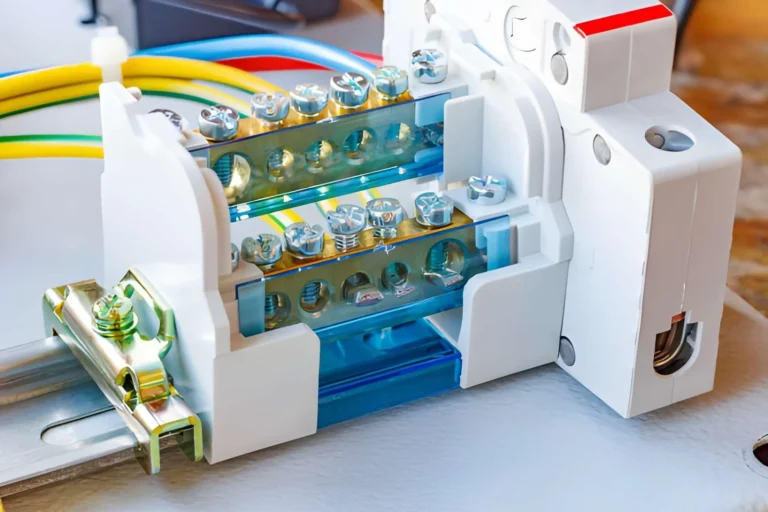
Terminal blocks are among the most common connectors used in industrial settings. In their simplest form, they connect one wire to one circuit, creating a single-pole link. More advanced DIN rail connectors can support additional levels, enabling multiple parallel connections. These are often separated by barriers, which is why they are sometimes called barrier terminals. Larger versions may include several connection points arranged in rows.
DIN rail terminal block connectors create stable, semi-permanent connections. At the same time, they allow for easy maintenance. Wires can be adjusted, replaced, or repaired without much difficulty, making them practical for systems that need regular changes or upgrades.
DIN Rail Terminal Block Types
DIN rail terminal blocks come in many designs to suit different tasks. Their small size makes them flexible and easy to install, even where space is tight. For very compact setups, miniature and micro versions are available.
Some models include built-in fuses for added protection. These are useful for sensitive devices such as sensors and relays. The fuse breaks the circuit if the current becomes too high, and many designs include an LED indicator to show when it has blown. These are often called fuse terminal blocks. In some cases, color markings are used to show different current ratings.
Another way to classify them is by levels. A single-level block connects one wire path. A dual-level version adds a second connection stacked above the first, doubling capacity without taking extra space. There are also triple and four-level options, as well as more advanced designs with eight or even sixteen levels for high-density wiring.
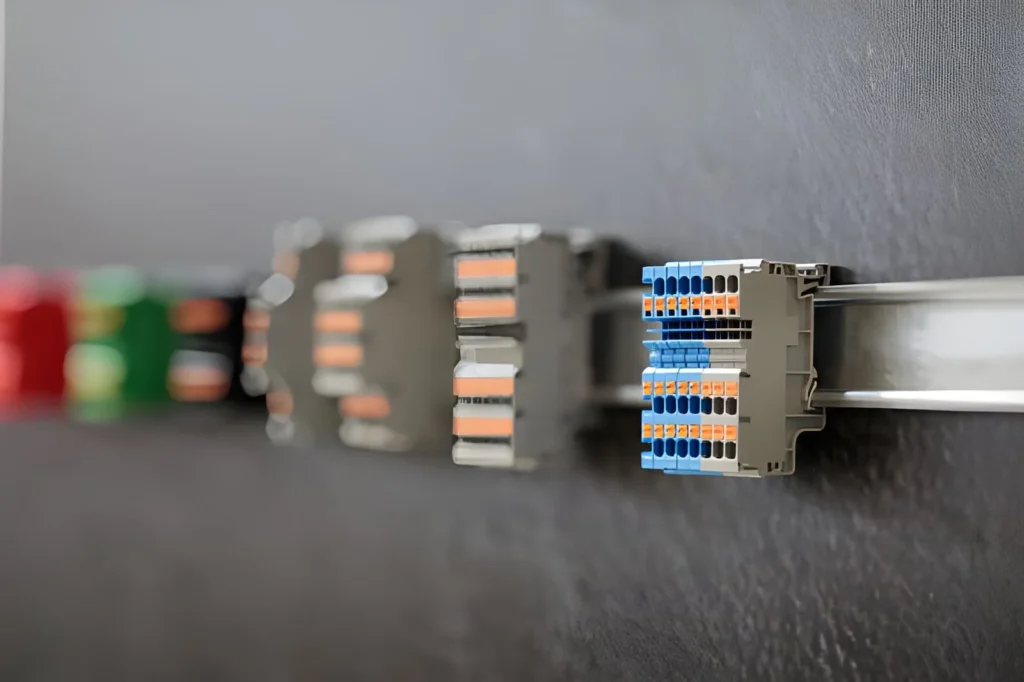
They can also be grouped by how wires are connected. Screw terminal blocks are widely used and rely on a screw clamp to hold wires firmly in place. Some versions use spring-loaded clamps to improve stability, especially in environments with vibration. Ring or push-in terminal blocks allow faster installation, as wires can be inserted directly without loosening screws. These are usually compact and often support multiple connection levels.
Earth terminal blocks are designed for grounding. They connect wiring directly to the ground to safely discharge excess electrical energy. These blocks are easy to identify by their green and yellow casing and are typically secured using screws or clamps.
DIN Rail Terminal Block Sizes
DIN rail terminal blocks are designed to fit different cable sizes. To choose the right one, you need to understand how cable size is measured.
There are two common methods. One is diameter, which can refer either to the full width of the cable (including insulation) or just the inner conductor. The other is cross-sectional area (CSA). This shows the total size of the wire’s cross-section and is usually expressed in square millimeters (mm²).
CSA is not the same as diameter. It gives a more accurate idea of how much current the wire can carry.
When selecting a terminal block, make sure it matches the size of the cable. A proper fit ensures a secure connection and helps maintain safe, reliable performance.
How to Use a Terminal Block Connector
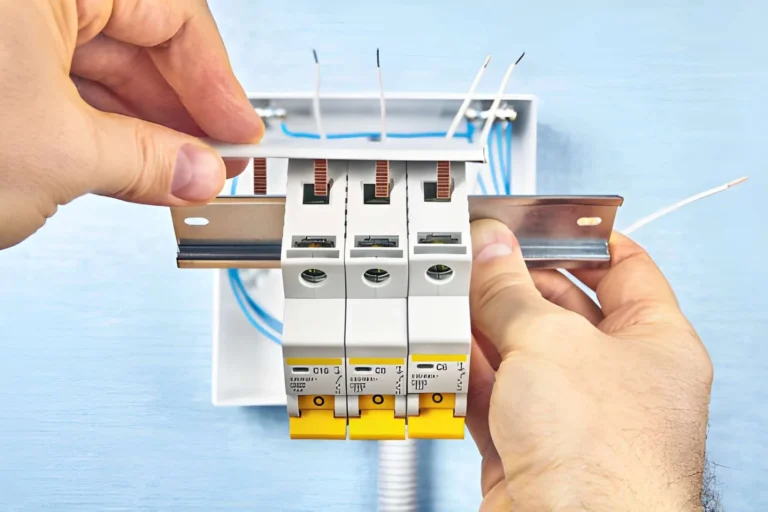
To use a terminal block connector, first attach it to the DIN rail. Clip the chosen, compatible connector onto the rail, then secure the rail assembly to the equipment panel or enclosure. Finally, connect the required wires to the terminals. DIN rail terminal blocks are designed for fast, straightforward mounting on the rail.
If the block is placed at the end of a row, you can fit an end plate to the open side to cover and protect it. You can also use an unconnected terminal block to close off the row. In all cases, the end block or end stop should lock firmly onto the rail so that the blocks cannot slide along it.
How to Wire DIN Rail Terminal Blocks
For standard screw-type DIN rail terminal blocks:
- Switch off and isolate the equipment.
- Strip about an inch of insulation from the end of each cable.
- Loosen the clamping screw on the terminal entry, insert the bare conductor fully, then tighten the screw firmly. A loose screw can cause overheating and melt the insulation.
- Note that slots may be on the top, front, or side, and the number of slots depends on the block design.
- Repeat for each wire that needs to be connected.
- Clip the wired terminal block onto the DIN rail.
If your block uses spring or clamp connections instead of screws, press or lever the spring open with the supplied tool, insert the stripped conductor, and release the spring to lock the wire in place.
For plug-in terminal blocks:
- Position the terminal block where you want it.
- Plug the wires from your equipment into the block, matching male and female terminals.
- Tug each wire lightly to confirm the connection is secure.
For ring terminal blocks:
- Place the wire’s ring terminal over the stud or post.
- Close the self-locking safety wing, if provided.
- Tighten the nut so the ring is firmly clamped in place.
How to Remove DIN Rail Terminal Blocks Safely
To remove DIN rail terminal blocks safely, first switch off the power supply and confirm that the circuit is isolated. Never attempt to remove a terminal block from a live system.
Most DIN rail terminal blocks include a locking foot or clip at the base. Use a suitable tool to release this locking mechanism carefully. Once released, lift or slide the block away from the rail according to its design.
While removing the block, avoid pulling hard on the wires or twisting the housing. Excessive force may damage the terminal block, rail, or conductor. If the terminal block is still connected to wiring, label and document the circuit first to make reinstallation easier.
Safe removal is important during maintenance, replacement, troubleshooting, or system upgrades.
How to Choose the Right DIN Rail Terminal Block
Choosing the right DIN rail terminal block depends on the application, electrical load, panel design, and maintenance requirements.
Here are the main factors to consider:
Electrical Requirements
Check the rated current, rated voltage, and conductor size. The terminal block must match the actual circuit conditions.
Connection Method
Screw clamp, spring clamp, and push-in connections each have different advantages. Screw types are widely used, spring types offer vibration resistance, and push-in types improve installation speed.
Application Type
Decide whether you need a standard feed-through block, ground block, fuse block, disconnect block, or multi-level terminal block.
Panel Space
If space is limited, compact or multi-level options may be better. If service access is more important, larger spacing may be preferred.
Environment
For industrial applications, consider vibration, temperature, moisture, and dust. The material and design should suit the working environment.
Maintenance and Expansion
Choose a solution that supports clear labeling, future expansion, and easier troubleshooting. In many projects, this is just as important as the basic electrical rating.
A well-chosen DIN rail terminal block helps improve system reliability, wiring efficiency, and long-term maintenance performance.
Conclusion
DIN rail terminal blocks play an essential role in modern electrical and industrial control systems. They provide a safe, organized, and scalable way to connect wires, distribute power, and manage signal circuits inside panels and equipment.
By understanding how DIN rail terminal blocks work, how to wire them correctly, and how to choose the right type, engineers, panel builders, and buyers can improve both installation quality and system reliability.
If you are selecting terminal blocks for a new project, focus on the connection method, ratings, application type, and panel layout to ensure the best result.
FAQ
What are DIN rail terminal blocks used for?
DIN rail terminal blocks are used to connect, organize, and distribute electrical wiring in control panels, industrial equipment, and automation systems.
How do DIN rail terminal blocks work?
They work by securing conductors through an internal metal contact system inside an insulated housing mounted on a DIN rail, creating a stable electrical connection.
How do you wire DIN rail terminal blocks?
You wire them by isolating power, preparing the conductor, inserting the wire into the terminal entry, securing the connection, and checking the wiring carefully.
How do you remove DIN rail terminal blocks?
You wire them by isolating power, preparing the conductor, inserting the wire into the terminal entry, securing the connection, and checking the wiring carefully.
How do I choose the right DIN rail terminal block?
Choose based on conductor size, current and voltage requirements, mounting standard, connection type, and application needs such as grounding or fused protection.
Looking for reliable DIN rail terminal blocks for your electrical or control panel project? Contact us to learn more about available types, specifications, and customized solutions for industrial applications.